Showing posts with label Art Institute of Chicago. Show all posts

Monday, August 12, 2013

Refinding, Losing - and abusing- Louis Sullivan (Again) - Buildings Burn, Landmarks are Reborn, and an Essential Monograph goes Out-of-Print

Louis Sullivan - clicks images for larger view
It was supposed to be a celebratory year.  2006 was the 150th birthday anniversary of Chicago architect Louis Sullivan.  With his partner Dankmar Adler, he had created some of the most striking masterpieces of the first Chicago School.  Sullivan split with Adler after the economic crash that followed the 1893 World's Columbian Exposition, but even as his career entered a long, tragic decline, he continued to create astonishing works such as a series of small Midwestern banks, and the Krause Music store on Lincoln Avenue.
And there were a number of celebratory events, including the Chicago History Museum's Louis Sullivan at 150 website.  You could still see the restored spectacular theater of Adler and Sullivan's Auditorium Building . . .
and you could still shop at Louis Sulivan's Carson Pirie Scott . . .
But perhaps the most striking way Chicago choose to celebrate Louis Sullivan was to burn down three of his buildings in just a eleven-month span of 2006.
On January 6, Adler and Sullivan's 1890 Kehilath Anshe Ma’ariv Synagogue, which, as Thomas Dorsey's Pilgrim Baptist Church became known as the birthplace of Gospel Music, burned to the bare walls in a fire set off by a construction worker using an acetylene torch on the roof.
Then, on October 24th, a worker using an acetylene torch to take apart a boiler in the basement started another blaze that destroyed Adler and Sullivan's Wirt Dexter Building on Wabash.
The following month, one of the firm's last surviving residences, the George Harvey House, whose owner was reported to have wanted it demolished for a new condo development, burned to the ground in a suspicious middle-of-the-night fire.

Today, seven years after that trifecta of disaster, the Auditorium still stands, although its tower's backdrop is no longer the blue sky, but the blue of VOA's new dorm for Roosevelt University.
Carson Pirie Scott has almost received a major and welcome update.  Celebrating the death of the department store, Carson's shut its doors early in 2007 after over a century of doing business in Sullivan's landmark.   In 2001, Carson's had sold the building to developer Joseph Freed, and before running aground against the disaster that is Block 37, Freed had made Sullivan's building their calling card, with a $190 million investment that included Harboe Architects leading a team that restored Sullivan's intricate cast-iron ornament . . .
. . . and uncovering the ornament designing by Sullivan for an early 20th-century remodeling of 22 South Wabash . . .
Now renamed Sullivan Center, the former Carson's store has become something of a magnet for architecture and design.  It's currently the home for both Gensler Chicago and the School of the Art Institute and its Sullivan Galleries on the 7th floor.  Last year, the building was reborn as a handsome, two-level flagship for a flagship City Target, the retailer's concept for expanding beyond suburban malls into the center city.
Photographer Richard Nickel lost his life photographing another Adler and Sullivan masterpiece, the 1894 Chicago Stock Exchange Building, while it was being demolished in 1972.  The trading room, lovingly restored by John Vinci, was reconstructed at the Art Institute.  The great entrance arch was also saved and erected within a charming park at Monroe and Columbus, where you could actually walk through it . . .
. . . until 2009, when with the construction of Renzo Piano's Modern Wing, the Stock Exchange arch was left like a garden gnome, stranded and inaccessible in the middle of a ditch-like flowerbed.
2010: The Year of Louis Sullivan

Then, four years after the official 150th birthday anniversary, four seminal events finally gave Louis Sullivan his due.
First, here was Louis Sullivan's Idea, Chicago cultural historian Tim Samuelson's masterful overview of the life and architecture of the great architect.  Designed by graphic artist Chris Ware, it made full use of the Chicago Cultural Center galleries with a a display of carbon filament lighting and supersize photos that gave you a real feel of what it must have been like to encounter the vanished buildings.  Unfortunately, Cultural Center shows don't get catalogs, so the only thing left of this great show are the memories and this eccentrically shot video . . .

At about the same time, the Art Institute of Chicago mounted Looking after Louis Sullivan, a striking collection of photographs by John Szarkowski,  Aaron Siskind and Richard Nickel.
April saw the debut of Louis Sullivan: The Struggle for American Architecture, Mark Richard Smith's labor-of-love documentary on the architects life and art.
To top it all off, in September of the year, we really hit pay dirt with the publication of The Complete Architecture of Adler and Sullivan, a landmark book that was an epic of scholarship and storytelling by Ward Miller, John Vinci and Tim Samuelson.  First the first time, there was a catalogue raisonnĂ© of every project Adler and Sullivan worked on, lavishly illustrated, including a large number of eye-opening color photographs.

Finally, the legacy of Louis Sullivan was here for everyone to see, for all time.

Well, not really.  Quite understandably, the first edition of The Complete Architecture of Adler and Sullivan sold out quickly.  It is now out-of-print.  Amazon.com lists copies from $450 to $1218.  Another dealer will sell you one for $3508.  2010 ended with the book being acquired, along with the other assets of The Richard Nickel Committee, by The Art Institute of Chicago.  There has been no second edition, and, so far, none has been announced.

Louis Sullivan: the Rodney Dangerfield of great architects.

Refinding, Losing (and abusing) Louis:

Wednesday, March 20, 2013

The Shock of the New: 1/3 of Modern Wing Shuts Down in September, Picasso and Matisse head out for six month Texas excursion

click images for larger view
 It's been less than four years since the Renzo Piano designed Modern Wing of the Art Institute opened to great fanfare.  After this coming Labor Day, to much less fanfare, the third floor galleries, covering Modern European Art from 1900 to 1950, will be shutting down for over six months, as nearly 100 works, including 10 Picasso's and 10 Matisse's, are packed up and shipped to Fort Worth for the Kimbell Art Museum's exhibition The Age of Picasso and Matisse: Modern Masters form the Art Institute of Chicago.   Running through next February, it's billed as “the largest loan of its kind from the Art Institute.”
While the e-mail exchange I had with the Art Institute's Director of Public Affairs Erin Hogan was nothing less than responsive and pleasant, I still get the impression that the closing isn't exactly the museum's favorite subject for discussion.  When the Art Institute last had such a major gallery closing and made a major loan - again to the Kimbell, for its 2009 The Impressionists: Master Paintings from the Art Institute of Chicago - it was heralded with a press release quoting then President James Cuno  as being “thrilled” about the whole thing.  In contrast, searching the Art Institute website, I can find absolutely nothing about the upcoming Modern Wing closing.
Museums have been known to make such loans as a way of raising cash, but when a 2008 article in The Art Newspaper claimed the Art Institute would receive $2 million from the Kimbell, Cuno, in a New York Times interview, scoffed. “It was said by some that we rented the pictures. That’s just not what we do. The Kimbell is covering costs associated with mounting the exhibition, with producing the catalog and with reframing the pictures.” He declined to disclose the amount involved, as does Erin Hogan about the latest loan, which she says is “really just to ensure that the works can be seen while we work on the third floor. It's not a major source of revenue.”  If the amounts are really negligible, you'd think they'd just disclose it and end the controversy, but that doesn't seem to be in cards.

Similarly, Hogan paints the six month closing as no big deal.  “On the third floor there were a number of things we wanted to adjust and it just seemed to make more sense to do them all in one fell swoop rather than piece by piece.”
Two years ago, the museum filed a $10 million complaint in U.S. District Court against Arup, the structural engineers for the project, citing work that was “woefully inadequate”, including cracked concrete flooring and faulty humidity controls that resulted in condensation that fogged the glass of the facades.  The blades of Piano's “magic carpet” roof, designed to bring natural light into the third floor galleries in a way that was safe for the paintings, were said to whistle in high winds.  Hogan says that all the problems were fixed by the time of the May, 2009 opening.  The lawsuit against Arup was resolved about a year after it was filed.
When asked what this years renovations would consist of, Hogan responded “Many things! Repainting/refinishing all walls, podiums, pedestals; recalibrating lighting systems by moving light sensors and adjusting light filters; reweighting and adjusting motion detectors for doors; etc.  The lighting system in particular isn't problematic; it's just that the larger galleries ‘harvest’ more daylight than the smaller galleries, so that there can sometimes be inconsistent light levels as you move throughout the third floor. So we definitely wanted to make that adjustment to even out the light levels.”
I've always wondered if there wasn't a simpler, more cost-efficient way to get safe, natural light into the galleries than the complex ‘magic carpet’ Piano designed, which seems to exist in no small part to be an architectural billboard for the new building.   Piano has attacked the problem in parallel ways at his numerous other museum commissions.  At Atlanta's High Museum of Art, there are a hundred rooftop ‘sails’, mini-skylights that twist to defuse and focus the light.  Back at the Kimbell, Piano is constructing a new addition to Louis Kahn's iconic original building.  At $1470 per square feet, it makes the Modern Wing's $1114 look like a bargain.  Here, Piano deploys aluminum louvers that also incorporate photovoltaic cells to provide the building with power.  Kahn's design is famous for bringing natural light into galleries, but it does so more modestly, with aluminum reflectors hanging from the ceiling rather than the ornate sculpted Piano rooflines that Wall Street Journal critic Lee Rosenbaum says have become the “must-have fashion accessories of museum expansions around the country.”

In the final analysis, no one can begrudge the Art Institute taking the time to ‘fine tune’ the Modern Wing.  And yes, everything should be back in place by this time next year.  Move on; nothing to see here - I get it.  Still, I can't quite shake the nagging feeling that something's not quite right, that we should be expecting more from a $294 million building only four years old than having a huge chunk of it shut down for six months while the priceless treasures it was built to display are exiled out of view.

Wednesday, March 6, 2013

Pablo's Wireframes: The Architecture of Picasso's Dots and Lines

click images for larger view
Pablo Picasso shocked me.

I know.  Such a thing should be impossible, forty years after the artist's death, and a century after he began the career that would change the direction of Western Art.  And shock is no longer what you generally experience when you walk through Picasso and Chicago, the engaging new exhibition at the Art Institute which skillfully rises above the fact that the artist never set foot in America, much less Chicago.  It's an exhilarating, even comforting show.  Whatever their original provocation, the 250+ works on display, ranging from graceful traditional portraits to often violent abstractions, now all seem like old friends.

No, my shocking moment came with, of all things, a book. In 1927, French art dealer Ambroise Vollard commissioned Picasso to illustrate a new, limited edition of HonorĂ© de Balzac's novella, Le chef-d’oeuvre inconnu (The Unknown Masterpiece).  The story concerns the old painter Frenhofer, who has been unable to finish a single work for ten years, until he is introduced to a young woman who will become his new model.  She is so beautiful Frenhofer is inspired to quickly finish the painting, but he becomes so obsessed with a defect in his depiction of her foot that he goes mad, destroys the painting, and kills himself.  The short story, updated, was made into a famous, four-hour Jacques Rivette film, La belle noiseuse, with Michel Piccoli and a frequently nude Emmanuelle BĂ©art, and, much later, a suppressed episode of The Simpsons.

Picasso claimed to have become haunted by Balzac's tale.  Although it was not included in the 1931 reprint, he created his own woodblock, Le chef-d’oeuvre inconnu.  It was rediscovered in a junk shop in 1972, but that's another story.  In 1936, Picasso moved to a studio at No. 7 rue des Grandes-Augustin, believed to have been the house in which Balzac's novella began.  The following year he painted Guernica there.

The Picasso and Chicago copy of Le Chef-d’Å“uvre inconnu is kept under plexiglass, away from greasy hands.  Next to it, however, a video screen lets you move through the entire book, page by page.
It is an astonishing work of art, with no fewer than 13 etchings and 67 woodcuts, and various witty visual emendations, some in color.
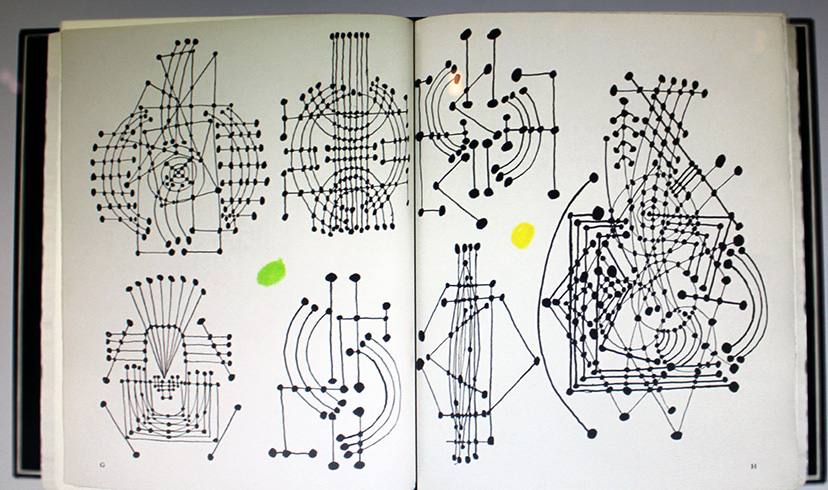
Most of the illustrations are richly figurative, one splendid drawing after another until, flipping through the pages, I came across this . . .
What are we looking at?  According to biographer John Richardson, in the summer of 1924, “The splendor of the meridonal sky . . . inspired Picasso to create his own constellations: ink dots connected by fine pen lines that turn the zodiac into guitars and mandolins and the crotchen-dotted staves of musical scores.”
In these sixteen pages of drawings, one can find the foundations of many of Picasso's works.   What struck me most, however, is how these dots and lines infer form, like a CAD wireframe.  It put me in mind of some of the drawings of Helmut Jahn.

In 1928, Picasso created four maquettes for a memorial to his late friend, the poet Guillaume Apollinaire.  It's as if he's lifted his constellations off the page - lines into iron wire and dots into small bits of steel plate -  and willed them into the third dimension.  The fleshy materiality of traditional sculpture, of brass and marble, is dissolved.  Picasso creates a pure 3-D geometry, form scrubbed clean of content.
When Picasso presented the maquettes to the committee raising funds for the memorial, they were rejected as too radical.  “What did they expect me to make,“ Picasso would comment later, “a Muse holding a torch?”

Only three of the small maquettes survive, but in 1972, shortly before his death, it was announced that Picasso would make a gift to New York's Museum of Modern Art of a 15-foot steel-rod sculpture, ‘Construction in Wire.’  It was a full-scale version of one of the Apollinaire maquettes, by now called his ‘drawing in air’ sculptures.  The work for MOMA was to be fabricated in Cor-ten steel, the same Cor-Ten used a few years before at the then Civic, now Daley Center, in what would be Picasso's most monumental sculpture, his gift to Chicago.
Picasso was not an architect.  As can be seen in his dot and line drawings, however, the way he thought about form, space and volume would be the envy of most architects.  You might call him the first Parametricist, but my gut feeling is that Picasso forgot more than Patrik Schumacher will ever know.
Picasso and Chicago runs at the Art Institute through May 12, 2013.  It is not to be missed.  Take my advice: carve out time during your visit to find those mesmerizing 16 pages.

Tuesday, January 15, 2013

Judith Russi Kirshner named Art Institute Deputy Director of Education


The Art Institute of Chicago has announced the appointment of Judith Russi Kirshner . . .
photograph: Charlie Dietz
as the museum's new Deputy Director for Education and Woman's Board Endowed Chair following a national search. In this newly created position, Kirshner will evaluate all of the museum's educational efforts, collaborations, and partnership programs, and work across the museum and the city to shape a future-oriented and holistic approach to education, outreach, programs, and audiences. Kirshner's appointment reflects a renewed and systematic effort on the part of the Art Institute to expand the museum's audience, enrich the experience of all visitors, and improve access to the museum's renowned collections and exhibitions. She will assume her new position at the Art Institute on March 1, 2013. 
Kirshner resigned last November as the Dean of the College of Architecture and the Arts at the University of Illinois at Chicago.

Full text of today's press release after the break.


ART INSTITUTE ANNOUNCES APPOINTMENT OF JUDITH RUSSI KIRSHNER AS 

DEPUTY DIRECTOR FOR EDUCATION AND WOMAN'S BOARD ENDOWED CHAIR
Kirshner to Help Reshape Museum's Educational Mission and Programs for 21st Century

The Art Institute of Chicago is pleased to announce the appointment of Judith Russi Kirshner as the museum's new Deputy Director for Education and Woman's Board Endowed Chair following a national search. In this newly created position, Kirshner will evaluate all of the museum's educational efforts, collaborations, and partnership programs, and work across the museum and the city to shape a future-oriented and holistic approach to education, outreach, programs, and audiences. Kirshner's appointment reflects a renewed and systematic effort on the part of the Art Institute to expand the museum's audience, enrich the experience of all visitors, and improve access to the museum's renowned collections and exhibitions. She will assume her new position at the Art Institute on March 1, 2013.

"I am thrilled to welcome Judith to the Art Institute," said Douglas Druick, President and Eloise W. Martin Director of the museum. "Like all other cultural organizations, the Art Institute finds itself in the midst of enormous cultural change, which is reflected in learning styles, models of access to information, and the nature of education itself. It is critical to the museum and its mission that we adapt to these changes and serve as a leader in redefining the role of 'museum education' with a known educational innovator at the helm. Judith is a well respected art historian, curator, author, and educator, and she brings to the museum not only decades of professional accomplishments in the arts but also a deep knowledge of and engagement with the city, visionary ideas, a collaborative spirit, and vast administrative experience at a major Chicagoland institution, where she has been rightly recognized for her creativity and achievements. We are all looking forward to working closely with Judith in the years to come to transform the Art Institute for its 21st-century visitors."

The Department of Museum Education currently serves a diverse range of constituents and purposes, including teacher education programs and curricula development; school programs for approximately 300,000 students per year; weekly family activities; and adult education programs that range from daily gallery talks and lectures to symposia, seminars, and performances. The department is responsible for hundreds of programs and events per year, both inside the museum and throughout Chicagoland via multiple partnerships, tied to both the permanent collection and approximately 30 special exhibitions every year. Given the broad reach of the Department of Museum Education, Kirshner will play a central role in redefining the experience of the museum for all visitors. She will work closely with museum curators in producing programs and interpretive content, develop the museum's schedule for performances and concerts, forge new partnerships both inside the museum and School of the Art Institute as well as reach locally and nationally outside the institution, and integrate new models of thought about education into all activities at the museum.

"I am very pleased to join the Art Institute and its remarkable staff in this exciting opportunity to reimagine programs, enhance and expand dialogues within the large cultural community of Chicago, and engage multiple audiences in innovative models of learning and interpretative experiences for the future," said Kirshner. "Such educational challenges provide a foundation for dynamic collaborations in learning, and I look forward to being a part of an institution embracing these challenges and creatively moving ahead."

Since 1998, Kirshner has served as the Dean of the College of Architecture and the Arts at the University of Illinois at Chicago (UIC). Her leadership over the past 15 years transformed the College of Architecture and the Arts at UIC into a nationally and internationally recognized leader for education in architecture, design, and the arts. Her tenure at UIC has been marked by her strong commitment to the recruitment and retention of an outstanding and intellectually diverse faculty, staff, and student body; her advocacy and articulate representation of the work of the College; and her rigorous re-evaluation and restructuring of the College's academic programs and leadership structure to build the strongest degree programs possible. Her most significant initiative, which will become official in August 2013, is the reorganization of the College into four academic schools (Architecture, Design, Art & Art History, and Theatre & Music), reflected in its new name, the College of Architecture, Design, and the Arts.

Kirshner first joined UIC in 1990 and served as director of the School of Art and Design from 1990 to 1997, where she engaged college faculty, staff, and students, as well as university-based leaders and external partners in major Chicago cultural institutions and community organizations, in wide-ranging endeavors. Part of the multi-college, multi-disciplinary effort to establish the UIC Innovation Center, Kirshner also brought the Jane Addams Hull-House Museum into the College to strengthen and reinforce the museological and public programming reach of this major historical and cultural destination. Under her leadership, the College of Architecture and the Arts received grants from the National Endowment for the Arts, National Endowment for the Humanities, Graham Foundation, Driehaus Foundation, Illinois Arts Council, Polk Bros. Foundation, After School Matters, and the Chicago Community Trust. Kirshner also led the effort to bring a commissioned work by the artist James Turrell, the UIC Skyspace, to the South Campus and led the initiative to identify and make accessible the Campus Art Collection, which contains the work of many outstanding UIC faculty artists.

Kirshner is also a recognized scholar and critic. Recipient of the Warhol Foundation Award for Criticism, she has focused her scholarship and publications on contemporary art, in particular Italian artists and feminist movements. A contributor to Art in America and Artforum , Kirshner has also published and lectured on the work of artists Judy Ledgerwood, Gordon Matta-Clark, Roni Horn, Tom Otterness, Dan Peterman, and Karen Reimer. She is a member of the City of Chicago Department of Cultural Affairs and Special Events advisory board, as well as an advisory board member of many national and Chicago-based cultural organizations. She previously served as curator at the Museum of Contemporary Art, Chicago, from 1976 to 1980 and at the Terra Museum of American Art from 1985 to 1987. From 1981 to 1987, she was an assistant professor in the art history department of the School of the Art Institute of Chicago.

Photo of Judith Kirshner by Charlie Dietz.

Saturday, January 12, 2013

Esra Akcan on Kreuzberg, plus Neil Brenner, Terry Guen, Jeanne Gang - more for January

Yes, we're still adding great new items to the January Calendar of Chicago Architectural Events.

This Wednesday, January 16th at the Graham, professor and author Esra Akcan will be talking about about News from the Living Room:  Storytelling and Participatory Architectural Writing, exploring the International Building Exhibition that commissioned designs for public housing from architects from Aldo Rossi to Rem Koolhaas to Zaha Hadid, to name just a few, to transform Kreuzberg, a Berlin neighborhood populated largely by Turkish immigrants.

Then on Monday, January 28th, also at the Graham, Archeworks is sponsoring a talk by Neil Brenner, the Urban Age in Question, that critiques contemporary ideologies and how "the geographies of urbanization . . . today encompassed diverse patterns and pathways across the planetary sociospatial landscape . . . "

There's a double dose of Studio/Gang Architects at the Art Institute this week, with curator Karen Kice leading an overview of AIC's exhibition Building: Inside Studio Gang Architects on Tuesday, and Jeanne Gang, herself, discussing her firm's recent projects at Fullerton Hall on Thursday.

On Wednesday, landscape architect Terry Guen lectures at CAF lunchtime, while on Thursday, Matt Seymour discusses Randolph Tower (a/k/a Steuben Club) Terra Cotta Restoration at the Cultural Center for Landmarks Illinois.  (Friday's Pecha Kucha Night at Olympia Centre is wait-listed.)

There are a dozen great items this week, and over two dozen between now and the end of the month, so check out the January Calendar of Chicago Architectural Events.

Friday, January 11, 2013

The ghost of the Art Institute's vanished Columbus Hall: Swami Vivekananda remembered on 150th birthday

Before there was Art, there was Religion.  When its new, $625,000 building opened on May 1, 1893, the Art Institute of Chicago continued to do business at the building across the street, at Van Buren and Michigan, that Daniel Burnham and John Wellborn Root designed for them little more than a decade before.

During the course of the 1893 World's Columbian Exposition, the Art Institute building was headquarters for the World Congress Auxiliary and a 17-day-long Parliament of the World's Religions.  On opening day, a young Hindu monk rose to speak, and created a sensation with a talk on religious tolerance that would make him one of the century's most famous religious leaders.

Tomorrow, January 12th, marks the 150th birthday of that monk, Swami Vivekananda, and the Art Institute is celebrating with repeated showings, from 11:00 a.m. to 3:30 p.m. in Fullerton hall, of a 29-minute documentary on the Swami.  It's free with museum admission.

The date of the Swami's speech?  September 11th, the same day the jets crashed into the twin World Trade Center towers 108 years later.  In 2010, artist Jitish Kallat created an extraordinary artwork, Public Notice 3, that inscribed Swami Vivekenanda's words on the risers of the Art Institute's monumental staircase.
Read the entire story about Swami Vivekenanda at new Art Institute, and Public Notice 3 . . .

On the great stair of the Art Institute, fear and hope stream beneath your feet in color and light.

Monday, November 12, 2012

Update: Inside Studio Gang Archi-Salon to feature Gang, Gil, Jacobs, more

Not longer after we published our post below updating the November Calendar of Chicago Architectural Events, we received more information about the Archi-Salon being held this Saturday in conjunction with the Art Institute's exhibition: Building: Inside Studio Gang Architects.

The salon, Inside Out: Uncovering Possibilities from within the Discipline will look "into the new possibilities generated by approaching and exploring aspects of the architectural discipline from new and uncompromised perspectives [and] uncovering possibilities related to issues of context, materiality, space, and program in architecture."

The moderator will be Iker Gil, director, MAS studio, and editor in chief, MAS Context.  Panelists are scheduled to include Jeanne Gang, principal, Studio Gang Architects; Matthias Hollwich, co-founder, Hollwich Kushner (HWKN); and Michel Rojkind, founder, Rojkind Arquitectos. Respondents will include Kelly Bair, principal, Central Standard Office of Design; assistant professor, UIC; Julie Flohr, founder, Oisse Architects; clinical assistant professor, UIC; Grant Gibson, principal, CAMES/gibson; clinical assistant professor, UIC; Thomas Jacobs, principal, Krueck + Sexton; adjunct associate professor, IIT and Mary Pat Mattson, studio assistant professor, IIT.

The event will take place this Saturday, November 17th, in the Modern Wing architecture space, Galleries 283-285, from 2:00 to 4:00 p.m., and is free with museum admission.  More information here.

Thursday, October 4, 2012

Rescheduled: Saturday's Archi-Salon at Building: Inside Studio Gang Architects

We received a note from Art Institute Assistant Curator Karen Kice that, due to scheduling conflicts, the "Archi-Salon" led by Clare Lyster this Saturday inside the space of the Art Institute's new exhibition Building: Inside Studio Gang Architects, has been rescheduled to February 2, 2013.

Sunday, September 16, 2012

Fragments: Sunday on the Great Stair of the Art Institute with George (Seurat), Stephen (Sondheim), and Louis (Sullivan)

click images for larger view (recommended)
Pretty isn't beautiful, Mother
Pretty is what changes
What the eye arranges
Is what is beautiful.
     - Stephen Sondheim, Sunday in the Park with George
Lining the Great Stair of the Art Institute, late Sunday morning, a large crowd stood waiting for the appearance of the cast of Chicago Shakespeare Theater's new production of Sunday in the Park with George, the landmark Stephen Sondheim/James Lapine musical that spans a century from George Seurat in Paris in 1884, to another artist, also named George, in New York in 1984, both Orwell's prophetic year and the one following Sunday's 1983 Broadway debut.
A reproduction was placed at the top of the stairs of Seurat's A Sunday on La Grand Jette, just outside the gallery where the massive, much-loved original resides.  On cue, the entire first act cast, comprised of all  the major characters that appear in the painting, as well as Seurat, himself, walked past the gallery door out into the the architectural fragments gallery at the top of the staircase, and, before singing one of the climatic numbers of the musical, stopped to study for a moment some of items on display.

Art isn't easy.
Overnight you're a trend,
You're the right combination-
Then the trend's at an end,
You're suddenly last year's sensation.
 A painting that's fallen out of favor can be stored in a back room; a play is a text that can be recreated in full again.  A building that clings to life, either forgotten or in the way of a greater profit, even when it's some of the greatest art created by a genius like Louis Sullivan or John Wellborn Root, is simply destroyed, smashed into dust.  A painting or a play is a self-contained world; an architectural fragment is an invitation to imagine a world vanished.
Architectural fragments project the past into a building of today.  A work of theater, especially Sunday in the Park, synthesizes past, present and future into a drama of constants, the basic elements of human experience as fractals, iterated by the artist into a complex fabric leading us to feel more deeply the most essential moments of our own lives.
Sunday in the Park with George, directed by Gary Griffin, and starring Jason Danleley and Carmen Cusack,  opens September 23rd at Chicago Shakespeare's Courtyard Theater, where it runs through November 4th.
see more images after the break . . .