|
| click images for larger view |
If there's such a thing as original sin, there's also original charm. That's the feel-good karma that Wrigley Field and the Chicago Cubs have made a long life of, even down to today. As battle lines are drawn over major renovations to the landmark stadium, how they're to be paid for, and how they'll affect the surrounding neighborhood, it’s a good time to take a look at the three radically different ecosystems of Wrigleyville's past, present, and intended future.
Once upon a time - let's say, a day in September, 1965 - you could amble down to Wrigleyville and take in a day game. You had no choice; Wrigley had no lights. You may have driven down with your Dad, cruising down the street until you found a kid holding a sign directing you into an alley to a spot in somebody's back yard where you could park for a buck or two. Or maybe you had called in sick and come down via the Howard L or Clark Street bus.

Either way, you would have found yourself in a solid, working-class neighborhood, well-worn buildings ugly as sin and just as comfortable. If you had arrived early, you might have grabbed a beer and a burger at one of the taverns just outside the stadium, bought peanuts and a cap from a street vendor, or just looked into the shop windows. You'd pass through the turnstile and settle into the 35,000-seat stadium along with that day's other 550 other paid attendees and, season safely lost, watch the Cubs lose to the Los Angeles Dodgers, with Sandy Koufax getting the save. You could look out past the outfield, past the bleachers, and see, on one of the rooftops of the many graystones that lined Wrigley along Waveland and Sheffield, some skinny old guy in bermuda shorts and a white T-shirt sitting in a lawn chair taking in the game, in one hand, a bottle of Meister Brau, in the other, a big, stinky cigar you would swear you could smell from your seat four hundred feet away.
The stadium and the team were the personal possession of one P.K. Wrigley, the taciturn son of chewing gum tycoon William Wrigley, Jr. The senior Wrigley had gained control of the team in 1918, and for decades ran the operation with his team President, Bill Veeck, Sr. Together they were known as the “double-bills”, a pun on the gum company's Doublemint brand.
The teams weren't always terrible, and when they weren't, the old stadium would fill and the streets would become a continuous mass of people, but the last year the Cubs made the World Series was 1945. The last time they won it 1908.
Here's really all you need to know to measure Wrigleyville then and Wrigleyville now. In 1977, P.K. was sent to the showers for the last time, and in 1981 his heirs sold the Cubs and their stadium to the Chicago Tribune - for $20,500,000, a figure only slightly more than the 2012 salary of just one player, Alfonso Soriano. When the Trib resold the team, after less than thirty years, to the Ricketts family in 2009, the price tag had escalated to $845 million. To understand the urban fabric of Wrigleyville today, just follow the money.
When the stadium, designed by architect Zachary Taylor Davis, was constructed in 1914 for Charles Weeghman's Whales, of the Federal League, the tall silos of a Coal and Coke distributor were right across the street. Most of the greystones we see today were already in place.
Then, Wrigley Field was part of the neighborhood. Today, it
is the neighborhood. Nowhere can you see the disruptive effect of the new Moneyball economics than among the greystones.
Those guys on the roof with their folding chairs have long since gone the way of the Potawatomi. As early as 1938, the Sheffield Baseball Club sold $5.00 rooftop seats for the World Series, but after the Trib bought the team, the trend hit warp speed, fueled by 1989 a Championship series sold-out in the stadium. Bare rooftops became slightly more finished rooftops, and then apartments became clubhouses. A guy named Tom Gramatis became a “rooftop mogul”, owning not just the Sheffield Baseball Club, but two other buildings, as well.
Instead of places to live, the greystones and their neighbors became, over time, the strange machines of a mutant urbanism, creating a Magritte-like architectural landscape where rooftop after rooftop is crowned with its own metallic bleachers. If baseball has become a billionaires' clubhouse, rooftop clubs are the millionaires outpost, with estimated annual revenues exceeding $20 million.
In 2004, in exchange for 12 more night games, Wrigley Field won designation as an
official Chicago landmark, with protection for historic elements such as the old scoreboard and ivy-covered brick. After the Cubs sued the rooftop owners and threatened to block their views, owners agreed in a 2004, 20-year contract, to giving the ballclub 17% of their take.
The battle to fix Wrigley: the end of public funding? Joe Ricketts could well be remembered as the man who ended the long run of sports teams building stadiums on the public dime. Valuations of sports club have reached astronomical heights - last year Forbes magazine put the Cubs at $879 million, fourth highest in professional baseball. Along with swelling revenue streams from escalating ticket prices and cable and TV rights, public subsidies have a lot to do with it. It was a great scheme: a team threatens to bolt a city unless it gets government to build it a new stadium. The taxpayer pays the bill; the owners reap the benefits.
Recent studies, however, call into question just how much public-funded stadiums actually benefit cities, especially when the cities are in the usual throes of fiscal crisis. In the case of the new, $639 million publicly-financed stadium for the Florida Marlins, it was revealed that just one $91 million loan has ballooned into a
$1.2 billion obligation for taxpayers
When new Mayor Rahm Emanuel came into office in 2011, he was disinclined to write the Cubs any blank checks. Even so, he was reported to be ready to sign off on a plan to split the costs of $300 million in Wrigley renovations - $150 million from the Ricketts; $150 million from easing the landmark restrictions to allow for more advertising. Other plans - for a Tax-Increment-District, or for allowing the Ricketts to divert future increments in amusement tax revenues from general use to funding Wrigley improvements - were also floated at various times.
And then came old man Ricketts. At the height of the 2012 Presidential campaign, the Wall Street Journal ran a report that family patriarch Joseph Ricketts was about to help bankroll $10 million in virulent, racially-tinged ads attacking Barack Obama.
Suddenly, Tom Ricketts, Joe's son and the guy who was actually running the Cubs operation, couldn't get Rahm to return, must less take his calls. Usually a man of sweetest temperament, Emanuel, Obama's former Obama Chief-of-Staff , was said to be “livid”.
As the Ricketts were left dangling in the wind, they waited, and then they went back to the drawing board. Last month, they came up with a
new plan for Wrigley, one that asks for
zero dollars in public funding. In exchange for a commitment of $300 million over five years for renovations, the Ricketts would get what Emanuel has called “
The Fenway Plan”, after the $285 million rehab plan for the stadium used by the Boston Red Sox. Let the Ricketts accumulate the revenue they need by removing limitations on the number of night games, easing some landmark protections, and shutting down Sheffield and Waveland for game-day street fairs.
Worried rooftop owners are fighting back, trying to stop closing the streets on game days, and coming up with a counter-proposal to allow the Cubs to place advertising signs, not at Wrigley Field, where they might block rooftop views, but on the rooftops themselves, producing perhaps $10 million in new revenue, to be shared with the Cubs, who quickly dismissed the idea. (Is it just me, or does
this mockup look especially cheesy?)
In its modern prime, Wrigley Field was the urbane alternative to the kind of isolated suburban stadiums, isolated among the expressways and moated with acres of surface parking lots, that sprang up in the 60's and 70's. More recently, however, new baseball stadiums have returned to the center city, emulating the attractive qualities of old classics like Fenway and Wrigley, itself. Ironically, the long-range plans of the Ricketts for Wrigley entail acquiring and developing a lot of the land on the ballpark's periphery, in essence making Wrigleyville more like those totally-controlled, self-contained, old-style "modern" stadiums.
The Ricketts already own the triangle that once held the Coal and Coke silos, later home to the one-story Yum Yum donuts. Originally, there was talk of building a large parking garage on the site, but right now it's highest use is as a winter skating rink.
Just last year, the family paid $20 million to acquire from McDonald's the large restaurant and parking lot the fast food chain owned across from the skating rink. Last month, the Rickett's announced a deal with Sheraton to construct a boutique hotel on the site. (Big Macs included - part of the 2011 sales agreement reportedly gives McDonald's the right to open a restaurant somewhere on the redeveloped property.)
Will the Ricketts continue to land bank their way through Wrigleyville? Rooftop owners retain a paranoid fear that the Ricketts's ultimate goal is to drive them out of business and buy up their properties on the cheap. And those aren't the only parcels that might be had at a bargain.
There's the Wrigleyville Hotel on Clark south of Addison, a $5 million boutique project that has yet to open.
The Ricketts/Sheraton deal also put the screws to developer Steve Schultz's plan for a proposed 137-room Hyatt Place that was to have had anchored Addison Park on Clark, a mega-development also featuring 135 apartments and nearly 150,000 square feet of retail. Addison Park would replace all the current buildings along the southeast intersection of Clark and Addison, except the abject Sportsworld store on the corner, which survives in the renderings as indomitable as a cockroach.
Schulz had been slowly acquiring the existing properties over the past several years. In 2010, there was an unveiling of project renderings by
Solomon Cordwell Buenz, but now faced with the Ricketts' hotel project, investors are throwing in the towel on their own Hyatt. The retail component also remains in question. At the time of the 2010 announcement, names being floated as potential retail anchors included the likes of Best Buy and Dominick's, big box marketers who now find their business models under siege by, respectively, the internet and Wal-Mart. Despite approval for the new project by the Chicago Plan Commission, all of the old threatened buildings - at the moment at least - remain standing.
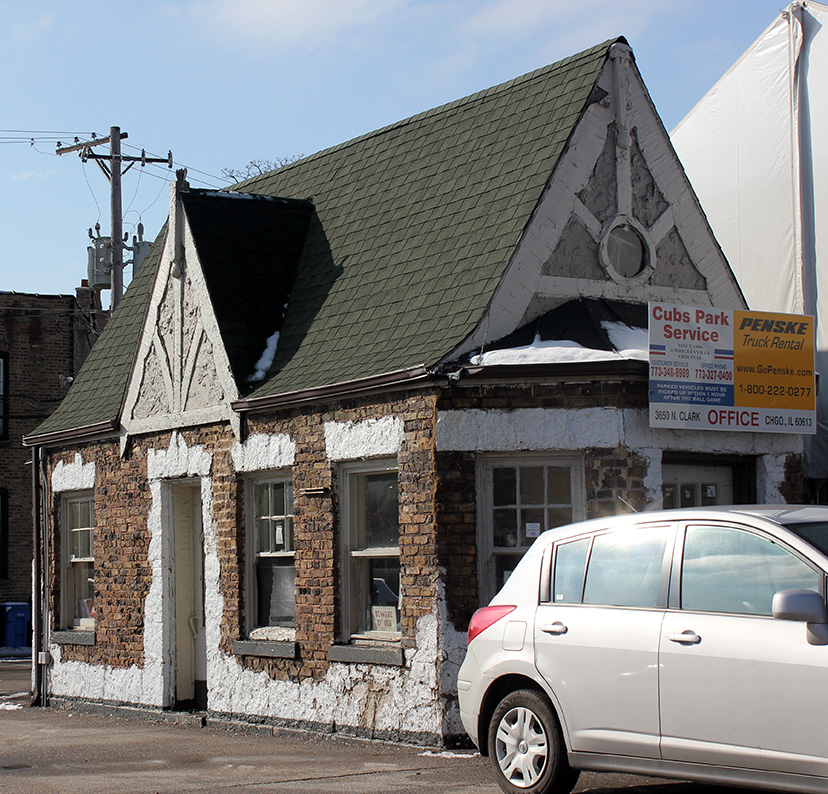
It's an interesting time. The thrust of the age of the supply chain is consolidation and scaling up, but on Clark street, you'll still find this tiny relic, originally a service station . . .
No matter how charming, such a building is simply inconceivable today. There is no scenario under which it could support any function returning an adequate profit. Similarly, when we walk past the condemned buildings of Clark Street, you find a hodgepodge motley of structures which, with the possible exception of the large cold storage warehouse, manage to both be too inconsequential to register any real individual presence, and too carelessly varied to resolve in any visually coherent way.
SCB's John Lahey challenged observers to find anything in this mix that would qualify as a great building, and he's absolutely right. This stretch of Clark Street goes beyond Rem Koolhaas “messy”; to full-up Sons of Anarchy territory. It's a succession of small businesses sucking everything they can out of peak times of the baseball season while jabbing elbows into each others guts to attract enough patrons to survive another winter. It's so graceless it's claustrophobic.
And yet, there's a raw vitality to this streetscene dump of parking lots, workhorse buildings of the homeliest kind, cell phone towers and crude massive billboards, this Improv Olympics of rowdy urban fabric, that SCB's polite mega-building will never be able to equal.
I once heard noted zoning lawyer Jack Guthman, arguing against what he saw as excessive landmarking, remarking that no one needs more Class C office space. The fact of the matter, however, is that it's the blue-chip tenants of the Class A buildings that you most often read about finding more and more ways to downsize their workforce. It's in the cheap, Class C space that you find the true entrepreneurs - trying, failing, trying harder, failing better - until one or two become the breakthrough companies of tomorrow. It's the same way with the small businesses along Clark and Addison. Some struggle just to keep the doors open. Most will never escape the shadow of their own neighborhood, but once in a while, one of them will create something entirely new, something that will radiate outward to enrich the character of the city.

There won't be room for those kind of dicey tenants in the big sparkling new building. There, they'll need high rents just to make back their investment, the kind of rents that only big chains with their heavy standardization and high dollar volumes can guarantee.
This conflict between the bureaucratic and the creative was referenced in a Monday
Tribune profile of Bob Mariano, formerly of the Dominick's grocery chain and now CEO of Roundy's, the Milwaukee parent of Mariano Fresh Markets. Mariano talks about the inspection of a deli department by a team from the Safeway mega-chain that had just acquired Dominick's. They asked how many varieties of potato salad were prepared for sale. Mariano answered seven. The Safeway response was “you only need three.” As you might imagine, a few years down the line, Dominick's is struggling to define itself and Safeway is closing locations. Mariano's, with its sparkling stores and goal of becoming “the Nordstrom of the grocery world,” is successful and expanding.
Real life has a way of confounding expectations. If you were up on the rooftop with that guy in the lawn chair fifty years ago, could you ever have imagined how it would all eventually play out with all those surreal mini-stadiums? There's no doubt that the Ricketts and developers like Schulz are looking to make Wrigleyville a lot more dense, a lot more uniform, consolidated and controlled, but if the recent history of this historic neighborhood proves anything, it's that nothing turns out exactly the way you plan. And that what keeps cities interesting and creative.