Showing posts with label exhibitions. Show all posts

Monday, July 22, 2013

Spider man

You always knew when it was a letter from Tony Fomison. That spindly handwriting crawling across the envelope like a chemically enhanced spider had unmistakable obsession steeped in a self consciously fashioned retro style. Fomison’s writing was as much a part of him as the hand that crafted the words and it appeared everywhere; on his letterbox (warning visitors to either make an appointment or leave him alone), on the bottom of his paintings carefully detailing the dates of various stages and iterations and of course in the many notebooks he kept over the years.
 

In a terrific small exhibition at the Auckland Art Gallery (down the back of the ground floor contemporary galleries) you can get a first-hand taste of Fomison’s personality. This is because it includes a vitrine displaying some of the archival material that is now in the Gallery’s collection along with the careful selection of paintings. It really is great to see the artworks alongside this source material including a couple of journals and items that were crucial to Fomison process and thinking. 

All up it’s like taking a sidewards peep into the studio, a work space that was always cluttered with magazines, books, torn out illustrations and notes and more notes. And how about those notebooks and those lists …  and all that crazy spindly writing.
 

Image: top, Tony Fomison in his Gunson Street studio in 1978. Bottom a detail from one of Fomison’s note books on view at the Auckland Art Gallery


Other OTN posts on Tony Fomison:
The missing Senator
Fomison lookalike
Looking like Fomison

Friday, July 19, 2013

Hollywood or bust

For your Saturday pleasure: ten ways the visual arts are following the movies

1. Stacking up a star system:
Thanks Larry, thanks Jay, love Jeff and Damien

2. Revealing behind the scenes
Insider info was the juice of the best Extras on DVDs. Now stop motion rules the day as art museums show us how they do their thing. Here the Dowse reveals back-of-house-moments with Kerrie Poliness.

3. Expanding the box office:
Get used to it. You might be able to get into the permanent collection for free but special exhibitions, you pay every time. Watch out for late night specials and packaging deals. Terrific Tuesdays

4. Setting the scene:
Paul McCarthy in New York with his White snow set and Urs Fischer in LA with his work Josh Smith a reproduction in movie set style of another artist’s studio.

5. Producing trailers:
The new way to promote art exhibitions online. Like the Art of Pop and Ian strange's exhibition Suburban at the National Gallery of Australia.

6. Playing sound tracks:
The iPod put to work giving sounds to the pictures. Z-Trip for Shepard Fairey's exhibition Sound & vision, Unfolding by Janek Schaefer for Future beauty, and at MoMA Tracks allows visitors to select tracks from their own music library to listen to while exploring the Museum or the MoMA App.
 

7. Establishing franchises:
The Guggenheim led the way but now the Louvre and many others are hard at it leveraging their cultural capital.

8. Play it again
When attitudes become form, this time re-jigged for 2013.

9. Credit lines
To everyone. Publications now include everyone from Trustees and preparators to the curator's wife and kids and as for the speeches at openings and there's room for everyone - lets not forget the end credits for Superman when it was released in 1978 took almost eight minutes to run and the credits for Lord of the Rings are probably still running.

10. The book of the show
And no, it's doesn't have top be an art history thesis. The V&A are about to mount an exhibition based on the specially commissioned story Memory palace by Hari Kunzru

And sometimes you don't even have to see the exhibition. Just see the movie of the exhibition. Grab a seat, it's Great Art exhibitions on Screen. Munch, Manet, Vermeer ...
 

Image: Philippe Parreno puts a movie theatre marquee on the Guggenheim

Thursday, July 4, 2013

A touching experience

Back in the 1970s a big problem was how to deal with the do-not-touch thing. Someone once said (it might have been Richard Killeen) that the New in New Zealand dogged us all making us very suspicious of patina and wear-and-tear, particularly in art. That’s why a Gordon Walters painting with even the slightest scuff can die in an auction whereas the finger prints and abrasions on the edges of a Mondrian can be regarded as a badge of honour, proof positive that this painting is part of the real world. It even went so far as exhibitions with titles like Touch in which all the works could be handled and even exhibitions for the blind (did we really do that?).

We saw a more pragmatic response to the do-not-touch problem in a Franz West exhibition at the MMK in Frankfurt. West was a passionate advocate of audience participation and in this exhibition (despite some collectors fearing the worst and not allowing their works to be handled) there was a significant opportunity to be part of the West experience. Sculptures to sit on, works to spin around, objects to slip over the arms (or if you were really up for it, the head) and wave about and a small sculpture that you could wrestle to the ground as one member of a school party did while we were there.


All this was made possible by the good will of some collectors and the use of exhibition copies of what Franz West called his adaptables. When you think about it, if you can make entirely new sculptures after artists die it's not too much of a stretch to create exhibition copies of works(with the artist's ok) for visitors to play around with.

Sunday, June 23, 2013

Inside the outside in

A great thing about New Zealand's Walters Prize in addition to the great artists who have won it, is the extraordinary line-up of curators who the Auckland Art Gallery have convinced to fly in to select those winners. Carolyn Christov-Bakargiev who in 2012 curated one of Documenta’s most thoughtful and dynamic outings was one, so too was Robert Storr who articulated MoMA’s collections for last decade of the twentieth century. But the first Walters Prize judge was the greatest of them all, Harald Szeeman who virtually invented the contemporary form of art curation with large scale exhibitions on ambitious themes. And of course it was Szeemann who memorably awarded the Walters Prize to Yvonne Todd.

Szeemann’s defining exhibition When attitudes become form held in the Bern Kunsthalle in 1969 has been re-presented this year during the Venice Biennale by the Prada Foundation. This complex venture was a collaboration by the architect Rem Koolhaas, artist Thomas Demand and the Foundation's director Gemano Celant. Their huge challenge was to convincingly present the Bern exhibition in Prada's eighteenth century palazzo Cá Corner della Regina. They did it by laying the floor plan of the kunsthalle over the spaces of the palazzo and creating something like a movie set.

To do this they built walls and recreated Bern details like skirting boards, doors and numbering systems but also left elaborate palazzo details as evidence of the overlap. The works were a mix of loans, reproductions, allusions and in a couple of cases, substitutions. This was not the expansive kind of installation we have become accustomed to but a spirited clamour of works and ideas in a compressed space.

The effect was extraordinary: something like the original exhibition, but with knowing references to the forty years that separate us from it. It was also refreshingly experimental, provocative and intriguing. To top it all there is a terrific (although expensive) publication which draws on the rich Harald Szeemann archives in the care of the Getty Research Institute in Los Angeles. Szeemann was famously a passionate recorder and keeper of the record. Given the enthusiasm over the material presented in the Prada exhibition we can probably count on the Getty publishing more of the Szeemann archive in the future.

Images: Top, Harald Szeemann’s drawing of the layout for the exhibition. Bottom left, Richard Serra’s Sign Board Prop installed on a huge photograph of the original Kunsthalle’s tiled flooring printed on vinyl and right, visitors cross Carl Andre's 36 Copper square to see the rest of the show.

You can read a less favourable response to the exhibition on EyeContact along with more pics of the installation.

Friday, May 31, 2013

Andy and 99 in 66

As Warhol hits Wellington here is an all but forgotten Warhol commercial job from the mid sixties that combines the Te Papa show’s interest in personalities, (Barbara Feldon as Agent 99 in the TV comedy Get Smart was a huge star) with popular culture. Felden’s clothes were designed by Gayle Kirpatrick and the photographs were taken by Roger Prigent. Even in the mid sixties and in spite of his growing fame and sales Warhol was convinced he had to keep the commercial work going. Thanks to assemblyplantmarietta for leading the way.

Sunday, May 26, 2013

Baby steps

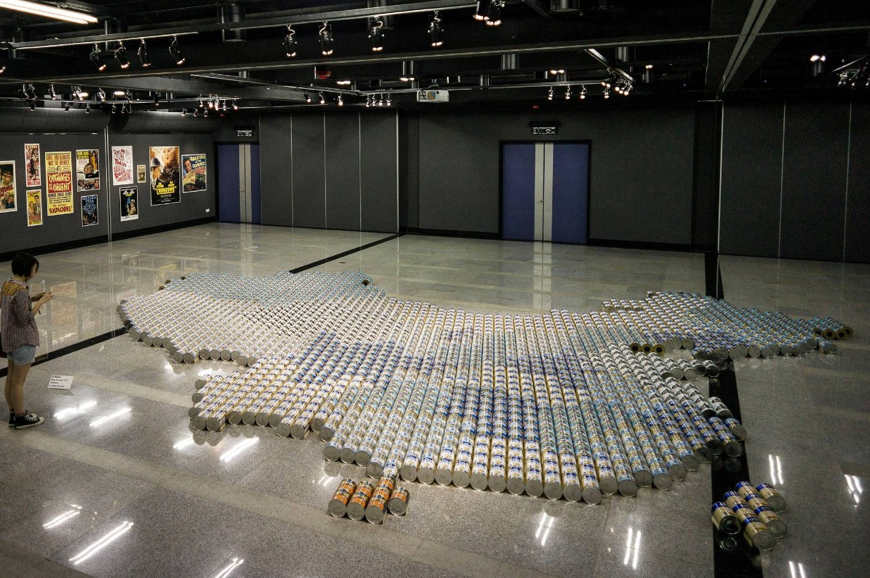
Here’s something you probably won’t see in an art museum in NZ anytime soon. Ai Weiwei has just shown Baby formula 2013. It is a giant map of China made from hundreds of cans of baby formula featuring popular brands. Back in 2008 New Zealand's Fonterra was involved in the milk formula scandals through its investment in the Chinese company Sanlu. In that instance three children died and many were hospitalised after drinking milk contaminated with melamine. Even now years later Chinese mothers still travel to Hong Kong to get what they perceive to be safe formula. Ai Weiwei says of his work, “This is a most fundamental assurance of food, but people actually have to go to another region to obtain this kind of thing. I think it's a totally absurd phenomenon."
Image: Ai Weiwei's Baby formula 2013

Wednesday, May 8, 2013

That was the year that was

Here’s an idea for an exhibition. Take a year and curate a tight selection of what was exhibited around town in that year. Well, not our idea but the New Museum in New York’s. What you got was a smart mix of art that was difficult at the time and has now come into focus, works that seemed important and now not so much, artists who were at their peak and others who were just about to break through. A fine curatorial sieve was set across time (1993) and place (NY) and yet as a viewer you had a lot of ideas to play with. The Museum is selling it as a time capsule but it's more an opportunity to step back and make a wider judgement than focus on quirky or outdated details as time capsules are notorious for doing. And to cap it off the Museum commissioned Rudolf Stingel to install an extraordinary floor covering that flowed from the elevators through the gallery spaces bringing the show together in a way bright orange carpet was never designed to do.
 
Images: top Rudolf Stingel’s carpet in a little side action as the lift opens onto the gallery space, second row left Felix Gonzalez Torres Untitled (couples)and right a detail from the billboard work untitled. Third row Derek Jarman’s Blue and bottom Charles Ray’s Family romance. All from 1993.

Monday, April 15, 2013

Show or perish


Apart from the tertiary community itself, the announcement last week of the PBRF (Performance Based Research Funding) evaluations probably passed most people by. And yet with static or diminishing funding from Creative NZ and philanthropy’s flagship Boosted struggling to get traction, what the visual arts get out of the $262.5 million allocated to tertiary research will have a major impact on what we see and read over the coming three or so years.

Here's how it works. Virtually all academic staff have to submit a detailed portfolio of their research over the previous three years for which they are given an A,B or C.. The higher your ranking, the more access to funding you have. In the visual arts this increasingly means highly subsidised or fully funded art works, exhibitions, and publications by university staff.

So how did our art schools fare in this funding gold rush? There are only three horses in this race: University of Auckland, Massey University and AUT. The art schools are part of the subject area Arts and Craft but fortunately this time round both Auckland and Massey also had the results for their art schools recorded separately.

Auckland University art school topped the list with 7 A researchers, 9 B researchers and 6 who came in at C.

Massey’s School of Fine Arts was a close second with 5 A researchers, 10.8 Bs and 8 Cs.

AUT's art and craft subject area results made it third with no A researchers, 6.8 Bs and 49.6 Cs.

The rest didn’t really feature.

The take away? Watch out for more public museum projects, large scale installations, publications and inclusion in cash strapped biennales and exhibitions both at home and abroad by the senior staff at Elamand Massey. The names of these funded rock stars will become more apparent as the years go by.

You can read the full PBRF report here.

Friday, April 5, 2013

Advice to collectors


Suck it up.
One of many cards filled in by visitors in response to the exhibition of a selection of 250 works donated by Viki and Kent Logan to SFMoMA. The loan includes works by Warhol, Hirst, Nauman, Richter and Basquiat.

Monday, February 25, 2013

Googling on: paint by numbers


In its exhibition WHIZZ BANG POP the Auckland Art Gallery is showing the Damien Hirst multiple Paint by Numbers (edition of 175). Lowering its market value at a stroke, they have taken the title literally and made themselves a ‘Hirst’ by following the paint-by-number instructions (it’s a bit like eating one of Paul McCarthy’s Chocolate Santas). More typically this work would be displayed as it is sold with the canvas untouched revealing its paint-by-number markings for the 90 spots. NOTE: The Auckland Art Gallery has since told us that when the work was purchased the edition had already been opened and the 'Hirst' painted presumably by its first owner. Word is that, perhaps inspired by this professional do-it-yourself spirit, a recent visitor prised open the paint box on display, took out one of the brushes, dipped it into one of the 90 pots of paint and had a go. Presumably their efforts to follow Hirst’s instructions will be conserved out.

Of course Hirst isn’t the first PBN artist. Warhol made a few back in 1962 as Do it yourselfpaintings (shop here) although now the worm has turned again and you can buy a PBN versionof Warhol Campbell’s Soup can. The original Paint by numbers concept goes back to 1950 when the Palmer Paint Company in Detroit came up with the idea. Overall this kind of PBN has had bad press in the art world. It is seen as the painting equivalent of Truman Capote’s great sniff at Jack Kerouac'swork, “That’s not writing, it’s typing.” Still, if you can muster up some irony you can buy sets here.

Thursday, January 24, 2013

The Warhol effect

Te Papa announced late last year that it will host a Warhol exhibition in June 2013 selected by its curator of contemporary art and acting senior curator Sarah Farrar. Metaphor aside, nine months is not much time to pull off what the museum must be hoping will be one of those if-we-show-him-they-will-come blockbusters. The works will be selected from the collection of Pittsburgh's Andy Warhol Museum (plus some local and Australian ring-ins one assumes) but having just seen the bloated three hundred work exhibition Andy Warhol: 15 minutes eternal touring Asia and also from the Andy Warhol Museum, it’s not going to be easy to get a great show.

Museums manage their collections on the principle of that airline safety instruction video - ‘Secure your own mask first before helping others.’ Institutions with iconic collections like the Andy Warhol Museum can't afford to disappoint their own audiences with anything less than the best possible sampling of Warhol’s work. The problem for borrowers then is that what tends to be left is the smaller, lesser known, less popular examples (often on paper rather than canvas and in the Asian show occasionally in facsimile rather than original). This situation made 15 Minutes Eternal a pretty drab affair. To make up the numbers far too many average works were included and this quantity over quality perspective was aggravated by an absence of curatorial point of view.

The challenge for Te Papa is satisfying the drive for a strongly marketed blockbuster against a smart show with a point of view. Warhol is not seen in New Zealand often. The last time was the highly focused show The Warhol look in 1998 at the Auckland Art Gallery which only managed to draw in less than half its projected audience of 50,000 and lost around $90,000.  Warhol is not an audience slam dunk but working with what’s available after the Asian vacuum cleaner has been through and making some other institutional loans (the country code for Australia is +64) let's hope for a sharp, focused exhibition of one of the most influential artists of the twentieth century. Whether that will be enough to draw the crowds and turnaround Te Papa’s declining attendance figures is another thing altogether.
Image: Diminishing returns. Top Andy Warhol boxes in the studio. Bottom left at the Andy Warhol Museum and right, in a tragically blurry photo taken against all odds, the slim pickings exhibited at the 15 minutes eternal exhibition

Sunday, January 20, 2013

What me warrior

There’s a great story about Marcel Duchamp (possibly apocryphal) who was seen at his retrospective exhibition in Philadelphia signing a Mona Lisa postcard for one of the visitors. A museum person suggested that given his famous intervention on the image, a signed postcard would be rather valuable. The next day Duchamp was sitting at a small table outside the exhibition signing a large stack of Mona Lisa postcards which were free to all. When asked what he was doing he replied, “Devaluing the currency.” 

We were thinking about this when we saw about fifty terracotta Warriors crated up and ready-to-go behind a small curio shop in Hong Kong. The heads were rather alarmingly packed separately. In 1986 some of the original terracotta figures were shown at the Auckland Art Gallery preceded by the usual blockbuster fanfare and rewarded with the usual public response. The public were rather less enthusiastic twenty three years later when a bunch of reproductions owned by touring exhibition guy Marshall Bird went round the country with good reason. A couple of years before a similar show had tried to slip through as the real thing at Hamburg's Museum of Ethnology but was outed by the Chinese as fakes to the embarrassment of all concerned. 

We saw yet another sorry stage in the warrior downward spiral at a bar last night. There, among the bar stools and tables, was a copy of a full size Terracotta Warrior with its head placed on a jaunty angle. As we took a pic one of the patrons leant over to take a closer look at the figure, turned back to his friend and said, “Unreal.” 

Images: Left Warriors to go in Hong Kong and right hard at work in a Wellington bar

Sunday, December 16, 2012

One day in the planning office of the Shanghai Biennale


Project Manager 1: What are we going to do about visitors touching the 
exhibits?
Project Manager 2: I assume it’s not up for negotiation that we have to let them in?
PM 1: Not that again.  You know our sponsors are adamant about that.
PM 2: High voltage…forget I even said that… I guess it’ll have to be stanchions again.
PM1: Agreed but this time I want them to be a bit more stylish.
PM2: We could get the marketing department off our backs for once and have them branded.
PM 1: Brilliant! What’s our brand colour?
PM 2: I’m told it’s bright orange.
PM 1: That should stand out and keep the buggers away from the work. Besides it could look quite striking.

And it did.

Sunday, December 9, 2012

Friends and neighbours


Since earthquakes obliterated Christchurch Art Gallery’s ability to operate normally, it has been very busy taking itself in new ways to the city and the country via outreach and the web. It’s been an impressive effort but it must have been depressing for them not to be able to continue with the large scale, big production value shows they were becoming known by. Given that, how did the large exhibition of Shane Cotton’s work curated by Christchurch’s indefatigable Justin Paton avoid becoming another casualty of the disaster and instead open this weekend? Through collegial cooperation, that’s how.
Brisbane’s IMA gallery has always been a strong supporter of New Zealand artists thanks to its director Robert Leonard. He got to Brisbane via head curating jobs at the Auckland Art Gallery and the Dunedin Public Art Gallery and has never lost his commitment to the art of his own country. Since he took over in 2005 Brisbane has had a pretty good taste of what’s on offer from NZ.
By agreeing to partner up with the Christchurch Art Gallery on Shane Cotton’s The hanging sky and launch it from the IMA, Leonard has not only made it available to Brisbane but has also ensured that with the grunt work done it will be shown in NZ too. Perhaps this Australian gesture will serve as a prompt to some of our own art museums. A partnership with Christchurch would be pretty helpful given their continuing lack of a building and a few exhibition posters with the line ‘in association with the Christchurch Art Gallery’ would be good for all of us.
You can see a sample of Shane Cotton’s paintings for the Christchurch Art Gallery/IMA exhibition here and some beautiful shots taken during the installation here.
Image: Australians loving Shane Cotton at the IMA opening in Brisbane

Sunday, December 2, 2012

Counter intuitive


Te Papa has just released its latest Annual Report covering 2011-2012 and it gives some interesting insights into how the institution is faring. Visitor numbers have pretty much flat-lined since a surge back in 2008; they are up three percent on last year but down 12 percent against the golden year of 2008. We didn’t see any hand clickers or door beams in a quick check yesterday so visitor numbers must be constructed out of surveys and sampling (the margin of error is not mentioned). Ticket sales are a very reliable form of counting but Te Papa chooses not to share them so no visitor numbers for paid exhibitions like Oceania: Early Encounters 

So why was 2008 such a strong year for Te Papa? The answer is in this year's Annual Report. “The strong visitor performance in 2008/09 can be attributed to successful choices around visitor experience, but especially Monet and the Impressionists, the Colossal Squid, and Rita Angus: Life and Vision.” Yes, art proved itself a major attractor for Te Papa (two of the Big Three 08 attractors) and is used constantly to push the brand. Of the seven shows Te Papa toured in New Zealand last year, five of them were art exhibitions.

Yet, art is still Te Papa's unwanted child relegated to unsuitable makeshift spaces up five flights of stairs or via a confusing lift/stair combo. The fact is Te Papa has still not put to rest the shadow of MONZ (Museum of New Zealand) in which the independence and credibility of art were gleefully destroyed by art bureaucrats. For a cold-water-in-the-face experience check out Gaylene Preston's extraordinary fly-on-the-wall documentary film Getting to our place. It's a chilling real-time record of the early development of Te Papa. You can view it here.

And what is Te Papa’s solution to the anti-art legacy instituted by Ken Gorbey and Ian Wedde? “Work is underway on the Proposition for Art project, which seeks to establish Te Papa as a nationally and internationally recognised premier institution for art and visual culture in New Zealand, from its earliest expressions to the present day”.

Next week we will have another look at the Te Papa report. Our question, where are the lost children?

Tuesday, November 27, 2012

F bomb

Watching a painter obliterate the familiar mural from the side of the Moore Wilson’s building in central Wellington reminded us that not only did these product images stop endless tagging (some weird code of ethics between muralists and taggers that works throughout most of the city), but also that they had been painted where some sloganeering from the early 1980s had been. 

This was the site of the abandoned Thompson Lewis building which had housed the exhibition F1 (Factory 1) in November 1982. It was the brain child of Ian Hunter (then acting director at the National Art Gallery) and Andrew Drummond who was also on staff. F1 was a big shambling show that featured over its 2,800 metres just about every sculptor working in New Zealand and some more brought in from overseas. 

The floors were taken up by large-scale installations like Extensums by Pauline Rhodes and in the upper rooms and amongst the beams Andrew Drummond practised his Shamanistic arts. Richard Killeen was there, so too was Peter Nicholls. In fact Nicholls's work Full stop (he convinced the New Zealand Army Engineers to drop a three tonne boulder on to a sheet of heated steel) was on view on the Wellington harbour coastline for years after but seems to have vanished when we looked for it the other day. 

 And the slogan connection? We’ve mentioned it before, “When is a factory not a factory? When it’s a closed shop.” 
Images: Top, mural out. Bottom left, Thompson Lewis back in the day. Right, Peter Nicholls Full stop

Sunday, October 7, 2012

A clash of symbols


We’ve mentioned before how hard it is to find out what’s being included in the big art exhibition supporting NZ’s participation in the Frankfurt Book Fair, but a Twitpic in the stream from Frankfurt let in a chink of light.  It shows a Peter Robinson triptych that features (among other elements) a version of the swastika. 
Although the swastika Robinson has chosen is the reverse of the Nazi one and shown on its side, its standing in as a symbol of Nazism and the far right is self-evident. Not surprisingly Germany has specific laws prohibiting the use or display of the swastika even when done satirically or in opposition to Nazism although this prohibition is usually limited to the specific swastika design used during the Nazi era. 
Robinson in his use of the symbol is of course addressing the continuing and disruptive power of the far right internationally as well as in New Zealand and pointing out how far we are from reaching some level of real equality.
Still, you’d have to say including this work in an exhibition in Germany is certainly a stand-up provocative act of curation. After all the curators will be aware of the conflict that surrounded Jenny Harper hanging a similar Robinson swastika work in her Victoria University office back in 1998. Presumably, having taken the work into Germany, the curators, CNZ and the Ministry for Culture and Heritage are all prepared to stand behind it should there be any similar objections from a public somewhat more sensitive to these issues than we are. 
Image: Top, Peter Robinson’s work being readied for exhibition in Frankfurt. Bottom, the modification of a swastika to a less offensive form the Olympic stadium built in Berlin in 1936
LATER: You can now see a few images from the opening here on Barbara Walzer's photostream and more installation images on the St Paul’s Facebook page. 

Monday, October 1, 2012

Shock of The New

Returning to our car as we were about to leave Auckland, we came across the SOLD sign on the building that once housed both Auckland Art Gallery's NEW Gallery and Parsons Bookshop. This building was one of the most generous offers ever made to the visual arts in New Zealand (made by Jenny and Alan Gibbs with some cash from Chartwell) and it can't shuffle off with just a whimper.

There was talk at one stage that the building could be used by arts organisations or maybe as another contemporary art space but the energy to match the Gibbs’s generosity never eventuated. And along with the NEW went Parsons Bookshop, the only art bookshop in Auckland. On the weekend we asked at Unity Books on High Street if they stocked art books to be told, ”we don't have the room”.

Well thanks for that Unity.

So here's to some of the great stuff we saw at the NEW. Those incredible Henry Darger Vivian Girls drawings in Robert Leonard's Mixed-up Childhood, Natasha Conland’s stylish Chartwell collection presentation in which every object seemed to glow white, Richard Killeen’s survey The stories we tell ourselves, William McAloon’s Chartwell exhibition Home and away, et al's. Voice of silence installation as well as the installation that won the 2004 Walters Prize, the Urewera Mural in the McCahon Room, Robert Leonard's 2003 Chartwell exhibition Nine lives with its tribute to Giovanni Intra, With Spirit the Don Driver’s retrospective and the survey of Flying Nun Records.

And thanks for that, in a very different way, to Allan and Jenny Gibbs

Images: Left, sold and right the space formally known as Parsons