James Cuno wanted to make sure you noticed "the Frank Lloyd Wright red" of the Art Institute of Chicago's new logo. It was 2008 and Cuno, newly installed as AIC President, was talking to the New York Times about the rebranding effort he had initiated as the museum moved towards the opening the Renzo Piano-designed Modern Wing.
Neither Cuno nor his appointed curator of architecture, Joseph Rosa, wound up sticking around for long. Cuno now heads up the Getty; Rosa, the University of Michigan Museum of Art. The logo endures, but the commitment to Wright has its limits. The Frank Lloyd Wright Foundation announced Tuesday that the massive Wright archives, currently split between the two Wright homes, Taliesen in Wisconsin, and Taliesen West in Arizona, have now been acquired in a partnership between Columbia University and the Museum of Modern Art in New York.
While the Chicago Tribune was satisfied to first post the Reuters report on the announcement, and then a lot less informative rewrite, Crain's Chicago Business's Shia Kapos actually got the obvious questioned answered: Art Institute passed on Frank Lloyd Wright Collection. Kapos reports that the museum wanted to pick and choose what it wanted (Prairie School related, it appears) from the massive collection of 23,000 drawings, 44,000 photos, 300,000 (!) letters, models, furniture, and a partridge in a ginko tree.
On one level, the Art Institute's decision is understandable. I vaguely remember Rosa and/or Cuno talking about how the AIC was going to be more selective in its architectural acquisitions, and how the blunderbuss approach of accepting the entire output of architectural firms had tended to clog up the storerooms with a lot of stuff no one, quite possibly, was ever going to look at again. There are, after all, only so many Bertrand Goldbergs in the world.
Still, we're talking about Frank Lloyd Wright here, the most blue chip brand in American architecture. (If you don't believe me, check out the coasters, door mats, baseball caps and condoms on the Shop Wright website.) If they've passed on Wright, will we ever see the Art Institute acquire a major architect's archives again? Is Cuno's concept of the Art Institute as an encyclopedic museum mutating, where architecture is concerned, into an abridged version?
The Frank Lloyd Wright Foundation announcement video below . . .
Tuesday, September 4, 2012
Monday, September 3, 2012
Instead of gravel and chain-link, the Sound of Crickets on former VA site?
![]() |
| click images for larger view |
Reilly, also citing support from SOAR (Streetverville Organization of Area Residents), said Northwestern has now agreed to make good on promises made to the Chicago Plan Commission to make upgrades to the site while it awaits future construction.
Alderman Reilly is very pleased to report that his persistence has paid-off. The Alderman believes we have secured a solution that not only requires NMH to deliver on their promise to provide green space on the site, but will also provide some additional streetscape improvements."Improved lighting, secured fencing and chamfered corners to eliminate pedestrian blind spots" - cost undisclosed. Allowing Bertrand Goldberg's Prentice Hospital to live on in the rendering: priceless.
NMH will provide a 15-foot setback on the east and west sides of the site - including new wrought iron fencing to secure the entire perimeter as well as new and improved lighting. The interior planting area will include prairie grasses and wild flowers encircled by a sodded perimeter just beyond the fencing. Per the Alderman's request, NMH will also widen and repair the sidewalks on both Fairbanks and McClurg Courts.
Sunday, September 2, 2012
das HAUS to our house (Daley Plaza); plus Frank Lloyd Wright and the Japanese Print. (and - now in its 15th smash month! - no Prentice on Landmarks agenda)
The dance card for September continues to fill.
Between Friday, September 21st and Sunday 30th, the Das Haus pavilion will be setting up shop in Chicago's Daley Plaza, part of a twelve-city North American tour..
Frank Lloyd Wright and the Japanese Print
We keep adding to the September Calendar of Chicago Architectural Events. We're now nearing 60 items, and counting. Plus we've linked to another interesting exhibition at the Art Institute, The Formation of the Japanese Print Collection at the Art Institute: Frank Lloyd Wright and the Prairie School. which runs through November 4th in Gallery 107, the long print gallery, closed to the corridor, that's on your right after you enter the rooms for Chinese, Japanese and Korean Art.
As we wrote in our profile, Frank Lloyd Wright's Right-Hand Woman - Rediscovering Marion Mahony Griffin . . .
Wright's collection of Japanese prints led him to be an art dealer. In those frequent periods when his finances were wanting, the architect could usually raise ready funds through sale of some of his prints even as his advocacy of the art of those prints raised their profile, and, presumably, their sale value.
For now, don't forget to check out all the riches on September Calendar of Chicago Architectural Events.
(Spoiler Alert: Bertrand Goldberg's Prentice Hospital has been kept off the agenda of the Commission on Chicago Landmarks still again. This Thursday's meeting marks the 15th consecutive month of the Commission pretending the most pressing landmarks issue in Chicago doesn't exist.)
Between Friday, September 21st and Sunday 30th, the Das Haus pavilion will be setting up shop in Chicago's Daley Plaza, part of a twelve-city North American tour..
Das Haus is an exhibition that connects industry professionals in North America with the latest market-ready renewable and energy efficiency solutions from Germany. The project, supported by the German Federal Ministry of Economics and Technology, begins October 2011 and continues on a tour to 12 cities across North America over 13 months. Central to the exhibition is an integrated, fully functioning structure that applies real-world technologies and solutions that meet ultra-low energy building standardsThe 10-day stay will include tours, symposiums, seminars and discussions. We'll bring you more information as it becomes available.
Frank Lloyd Wright and the Japanese Print
We keep adding to the September Calendar of Chicago Architectural Events. We're now nearing 60 items, and counting. Plus we've linked to another interesting exhibition at the Art Institute, The Formation of the Japanese Print Collection at the Art Institute: Frank Lloyd Wright and the Prairie School. which runs through November 4th in Gallery 107, the long print gallery, closed to the corridor, that's on your right after you enter the rooms for Chinese, Japanese and Korean Art.
As we wrote in our profile, Frank Lloyd Wright's Right-Hand Woman - Rediscovering Marion Mahony Griffin . . .
It was a time when Chicago architects were in thrall to Japonisme, the late 19th-century obsession with art and culture from Japan. It's influence touched fashion, popular culture and music (Gilbert & Sullivan's The Mikado wasfirst staged in 1885), as well as French impressionist painters such as Monet, Degas and Van Gogh, who painted his own version of two woodprints by the Japanese master Hiroshige.
Wright was a major collector of classic Japanese woodprints, and, like many of his colleagues, a serial visitor to the Ho-o-den, a half-scale reproduction of an ancient Uji temple that was the real-life Mikado's presentation to the 1893 World's Columbian Exposition. Its simplicity and flowing space were qualities that came to characterize Wright's work.
According to Christopher Vernon, who writes of the Griffin's' work in Australia for the Block exhibition's catalogue,it was another architect, Birch Burdette Long, who brought the Japanese style to the renderings used to depict Wright's buildings. It was Mahony, however, who perfected it. Birmingham describes Mahony's style as “influenced by the sparse detail, continuous line, and skewed perspective and dramatic space of Japanese prints.” The other key element was the increasing importance of landscape, part of the march to an “organic” architecture. Just as Romantic painters were drawn to depicting classical ruins overgrown with vegetation, Mahony's renderings placed buildings within a rich landscape, “sometimes cascading over the floor plans” in her later works.
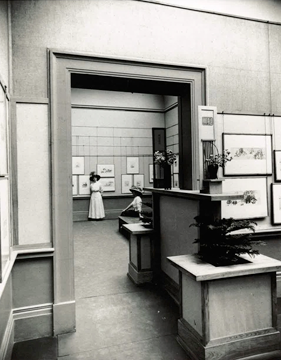
Wright's collection of Japanese prints led him to be an art dealer. In those frequent periods when his finances were wanting, the architect could usually raise ready funds through sale of some of his prints even as his advocacy of the art of those prints raised their profile, and, presumably, their sale value.
According to the Art Institute . . .
a photograph of the Japanese print exhibition Frank Lloyd Wright organized at the Art Institute in 1908.
courtesy The Art Institute of Chicago
Over the course of his lifetime, Frank Lloyd Wright consistently lent Japanese prints to the Art Institute, but his most important exhibition was undoubtedly a large show of prints he mounted at the museum in 1908 with an installation of specially designed frames and furniture. For the first time, museum visitors in Chicago were treated to a staggering array of Japanese prints from a variety of artists and time periods. The majority of the works on view were lent by Frank Lloyd Wright himself.I hope to see the show soon, and will report back.
. . . This exhibition is comprised of Japanese prints originally purchased from Frank Lloyd Wright, photos of the 1908 exhibition, as well as presentation drawings by Wright and his studio. Many of the drawings are by talented draftswoman Marion Mahony Griffin and show the incorporation of elements found in Wright’s Japanese prints . . .
For now, don't forget to check out all the riches on September Calendar of Chicago Architectural Events.
(Spoiler Alert: Bertrand Goldberg's Prentice Hospital has been kept off the agenda of the Commission on Chicago Landmarks still again. This Thursday's meeting marks the 15th consecutive month of the Commission pretending the most pressing landmarks issue in Chicago doesn't exist.)
Saturday, September 1, 2012
Souls in Flight Amidst the Proud Towers
![]() |
| click images for larger view |
Before approving the heliport, IDOT also commissioned its own study by Joseph F. Horn and Continuum Dynamics. While calling for reform of regulations, Chicago Mayor Rahm Emanuel expressed his support of the heliport last December.
The hospital is publishing regular reports on heliport usage, and for the first two months after the new facility was opened in June, the total number of flights was 20. The hospital's estimate of the annual number of flights at its former Lincoln Park complex was under 80. You can see an aerial view of 66-by-66 foot square heliport in this ABC7 Chicago report.
The shots you see here were taken this past Thursday. A helicopter coming in for a landing on the roof of a tall building between even taller towers in the sea of skyscrapers along Chicago's lakefront is dramatic enough. When you factor in the factors not only of aviation safety but of knowing the helicopter is transporting either a critically ill child or organs being rushed to a transplant, it pulls back the curtain on the indifferent skyscape of a densely constructed city, and intimates the life-and-death struggles, of both soul and of body, that are often taking place behind the blank facades.
Subscribe to:
Posts (Atom)


