Monday, September 24, 2012

What’s in that crate?

We’re figuring it was probably Jeffrey Harris’s large untitled drawing from 1982 that was in the then National Art Gallery’s exhibition The heart’s key. If so it would probably make this crate one of the last to have the old National Art Gallery stencil on it before it became The Museum of New Zealand and thence to Te Papa. Very humble protection compared to the monster crating public art galleries wrap their treasures in today. 
 Image taken at Art + Object at the day after the Paris Collection sale. 
A+O tell us that for the full 10 points the answer is in fact Neil Dawson's sculpture Framework II made in 1988 giving it even better creds for being one of the last NAG crates.

The curator’s egg

At a time when directors of art museums in  NZ have slid into more strategic and management roles, the job of curating has been largely left to the…er…curators. And it is a job under attack from all sides. 

From the left, the education department is pushing hard on how to develop appropriate experiences for specific audiences and how those experiences should be framed via labels, audio tours and public programmes. Coming from the right, the design department has removed curators from any physical contact with the work they select and has made the presentation of work its own area of professional expertise. And of course from all directions comes the marketing department with opinions about everything and the conviction its audience research ensures it always knows best. The curators have also played a part in their own relegation thanks to the comparatively recent concept of curating a single artist's installation (as in ”I am curating artist X to do a solo installation in Venice.") when in fact on many occasions they are just along for the ride. 

Then there is the elevation of the activity of choosing in the wider culture that has also played its part with people out there ‘curating meals’ in a restaurant, ‘curating the product in a store and ‘curating the news’ on TV. The old museum curatorial triumvirate of choose, present and preserve has been pretty much worn away with the 'choose' part just hanging on by a thread.

But, if you’re still keen to have a go, there are a number of university courses you can buy into here and the University of Auckland even has Ian Wedde, who developed the rationale behind Te Papa’s curatorial style, as a lecturer in its Art History department. 

Sunday, September 23, 2012

Im Daley Platz: Ist dies nicht ein Passivhaus? Ja, dies ist dasHaus.

click images for larger view
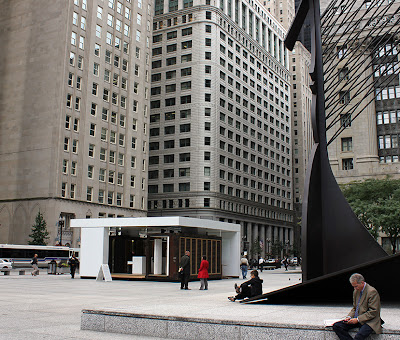
It's all about imagining a house that's so energy efficient, it generates all the power it needs, keeping it off the grid.  The official opening is 4:00 p.m today, Monday, September 24th,  but dasHaus Chicago has been set up in Daley Plaza since Friday, where it will remain until Sunday, September 30th.  It's a gleaming white construction built around two shipping containers, with everything fitting into a far larger shipping container for transport. It takes three days to put together and four days to take apart. 
dasHaus is the German American Chamber of Commerce's way of showcasing that country's advanced sustainable building technology.  There are photovoltaics on the roof and on the facade in louvered panels, charging an array of lead batteries.  Energy is captured as air is exchanged with the outside.  The lighting is LED, the appliances high-efficiency, the windows triple-pane.
Cutaways of different types of highly insulated wall construction are on display.
 
One of the shipping containers demonstrates the tightly-sealed and insulated energy-efficient environment, ingenuously designed, but more than slightly claustrophobic. 
In addition to regular tours of dasHaus at Daley Plaza, there are a number of other events, including a lecture by Passive House Institute US Executive Director Katrin Klingenberg at the Goethe Center, Monday at noon, and on Thursday the 27th, a dasHaus Chicago Conference and Networking Lunch, with half a dozen expert presents, at the Hyatt Regency Chicago.
Also on Thursday, there's Dubin Family Young Architect Tristan Sterk at AIA Chicago, and Les Albums des Jeunes Architects et Paysagistes at the Alliance Française de Chicago, while on Friday, there's a performance of June Finfer's musical, The White City, at Glessner House, and on Wednesday Jon Miller of Hedrich Blessing lectures at Crown Hall, IIT.


We may be in the last week of the month, but there are still over a dozen great items to check out on September Calendar of Chicago Architectural Events.


Overheads

No bees but right up there with art museum rooftop action is Wellington City Gallery that had a garden installed on its roof earlier this year. It’s supplying fresh organic greens and herbs to resident restaurant Nikau, an idea that comes from long-time Nikau chef Kelda Hains. The produce will be used to supplement the restaurants regular supplies. Thanks for the tip M

Question time

The Auckland Art Gallery has played the decision by the Walters Prize jury to select exhibitions they haven't seen pretty low key. Apparently efforts were made to get the four jury members to front up and explain their rationale, but they all declined. We certainly never got a response from them.

You can see the difficulty for the Gallery when the jurors wouldn't play ball but as they were paid for their services it's hard to understand how the Gallery could just roll over on it. Who's betting the jury contract is being revised right now?

Given all this, what do you think could have been going through the Auckland Art Gallery’s head when it decided to incorporate the jury’s odd behaviour into its marketing plan? We kid you not. The tagline for the Walters Prize poster campaign is: “Can you judge it without seeing it?” It feels defensive but is probably meant to be provocative and street-smart.

Thanks to the Walters Prize jury’s no-go-no-see policy we all know how they’d answer the question.

But now with the AAG’s marketing department forcing the issue so publically it’s probably time for the Auckland Art Gallery to come clean and let everyone know where they stand on it.

Friday, September 21, 2012

Big Shiny Things: Studio/Gang at Expo Chicago at Navy Pier

So here's the sketch . . .
click images for larger view
. . . and here's the reality . . .
Expo Chicago 2012 is now open, through Sunday, September 23rd in the huge Festival Hall at Navy Pier.  Organizer Tony Karman called on architect Jeanne Gang and Studio/Gang to design the 170,000 square-foot exhibition.

The idea was to recreate Chicago's street grid, complete with a zig-zag diagonal aisle cutting through the center, for east of navigation.  Frankly, the long rows of white-walled galleries didn't seem all that different from those I experienced at Merchandise Mart, with the difference of three huge mylar constructions hanging down from the 55-foot-high ceiling, alternating between concave and convex, demarcating what could be said to be the "parks" of this city, two food areas, plus that central lounge with its highly reflective dome that's kind of a cross between a hot air balloon and a giant coffee filter, picking up the colors and forms of the artwork.
The red carpet that was to mark the diagonal aisle like a flowing river apparently didn't make the final cut.  Interrupted by the lounge at the center, it makes the aisle seem less a diagonal, than the existing aisles doubling up in size as they approach the Mylar domes.

The domes do the job, however, of providing inescapable physical markers.  Wherever you are in the huge exhibition hall, at least one of the domes is in sight, helping you to set your bearings.
Each dome has its own character. The Chef's Cafe has a huge sphere inside at its center, illuminated with purple light.
The Signature Cafe is like a basket of thick mylar straps; the underside a warm overhang for the seating below it.
Expo Chicago 2012 has over 100 galleries represented, as well as special supersized installations by such artists as Jaume Plensa and Theaster Gates.  Get all the information  here.

Putting the mouse on the mat


The Disney organisation has always been expert at conning kids into believing all sorts of crazy stuff is possible.  Anyone who has been to a Disneyland knows that most sub-five year olds are pretty convinced that the giant Mickey Mouse is just that - mouse meat all the way through – and that’s why most of them cringe in fear at the first encounter. It’s only when they figure out that there is a human being inside the cossie acting as The Mouse that they go in for the leg hug.
It’s the same with Disney’s Magic Artistprogram (you can buy a copy here). If you were young you might be forgiven for thinking that from the packaging it was going to be more Jackson Pollock than Andrew Wyeth. After all, there’s the mouse letting loose on the canvas without a drop cloth in sight. Get into the program and it’s a different story. Magic Artist is just another drawing program that doesn’t even try to teach you to draw, just to make bad copies of black outlined cartoons. Sigh.