Showing posts with label audience. Show all posts
Thursday, August 1, 2013
Talk back
In this era when museums love to talk about participation and involvement one of the big questions is what can institutions expect their visitors to do for them? After all, it's those visitors who are usually footing the bill for the institution to develop expertise so asking everyday punters to 'contribute' to professional decisions kind of feels both patronising and in bad faith.
A classic recent example was the Georgia Museum of Art asked visitors to vote on which four of five similar paintings it should sell off (or, as it was put with the appropriate positive professional spin) which one “should we keep”! It’s an idea that has also been used by the DePaul Art Museum in Chicago (and will probably end up being used here one day). The DePaul invited “scholars from art history, philosophy, and anthropology—and visitors “ to “weigh in on the works of art and their fate”. You don’t have to be a genius to figure that the same public won't be asked to “weigh in” on which new works should be put into the collection. That sort of decision doubtless requires ‘experts’.
Sometimes though the contribution of visitors can stop you in your tracks. That was certainly the case with some Post-it type notes we saw pinned up in the Auckland Art Gallery’s Triennial Lab (it was during the AUT iteration). Visitors were asked to answer two questions central to curator Hou Hanru’s theme for the Triennial. “If you could live anywhere where would it be?” and “Why don’t you live there?”
One response could have stood in for the entire Triennial.
IF YOU COULD LIVE ANYWHERE WHERE WOULD IT BE?
“NZ”
WHY DON’T YOU LIVE THERE?
“Immigration problem”
A classic recent example was the Georgia Museum of Art asked visitors to vote on which four of five similar paintings it should sell off (or, as it was put with the appropriate positive professional spin) which one “should we keep”! It’s an idea that has also been used by the DePaul Art Museum in Chicago (and will probably end up being used here one day). The DePaul invited “scholars from art history, philosophy, and anthropology—and visitors “ to “weigh in on the works of art and their fate”. You don’t have to be a genius to figure that the same public won't be asked to “weigh in” on which new works should be put into the collection. That sort of decision doubtless requires ‘experts’.
Sometimes though the contribution of visitors can stop you in your tracks. That was certainly the case with some Post-it type notes we saw pinned up in the Auckland Art Gallery’s Triennial Lab (it was during the AUT iteration). Visitors were asked to answer two questions central to curator Hou Hanru’s theme for the Triennial. “If you could live anywhere where would it be?” and “Why don’t you live there?”
One response could have stood in for the entire Triennial.
IF YOU COULD LIVE ANYWHERE WHERE WOULD IT BE?
“NZ”
WHY DON’T YOU LIVE THERE?
“Immigration problem”
Sunday, July 14, 2013
Model behaviour
Looking at architect Peter Zumthor’s model for a proposed rebuild of the Los Angeles County Museum of Art we came across this strange scene. A murder? No weapon. An accident? No blood. Then we worked it out. Art Gallery – the Stendhal Syndrome.
Monday, May 27, 2013
Site specific
One thing you can say about NZ's museums and art museums is that we haven’t pillaged too much stuff from other countries - too late, too small, too distant. With strong Maori leadership we're also ahead in the repatriation of human remains although it’s estimated that around 500 Maori ancestral remains are still held overseas. And you do have to wonder why, say, a small university museum in Montreal needs to display the mummified body of an Egyptian or a treasured and sacred fetish figure from Africa.
And then there's the works that will never be returned, the countless religious paintings and icons and sculptures that have been stripped from their context and narratives and put in museums. When you do get to see a great artwork in its original setting it's a startling experience.
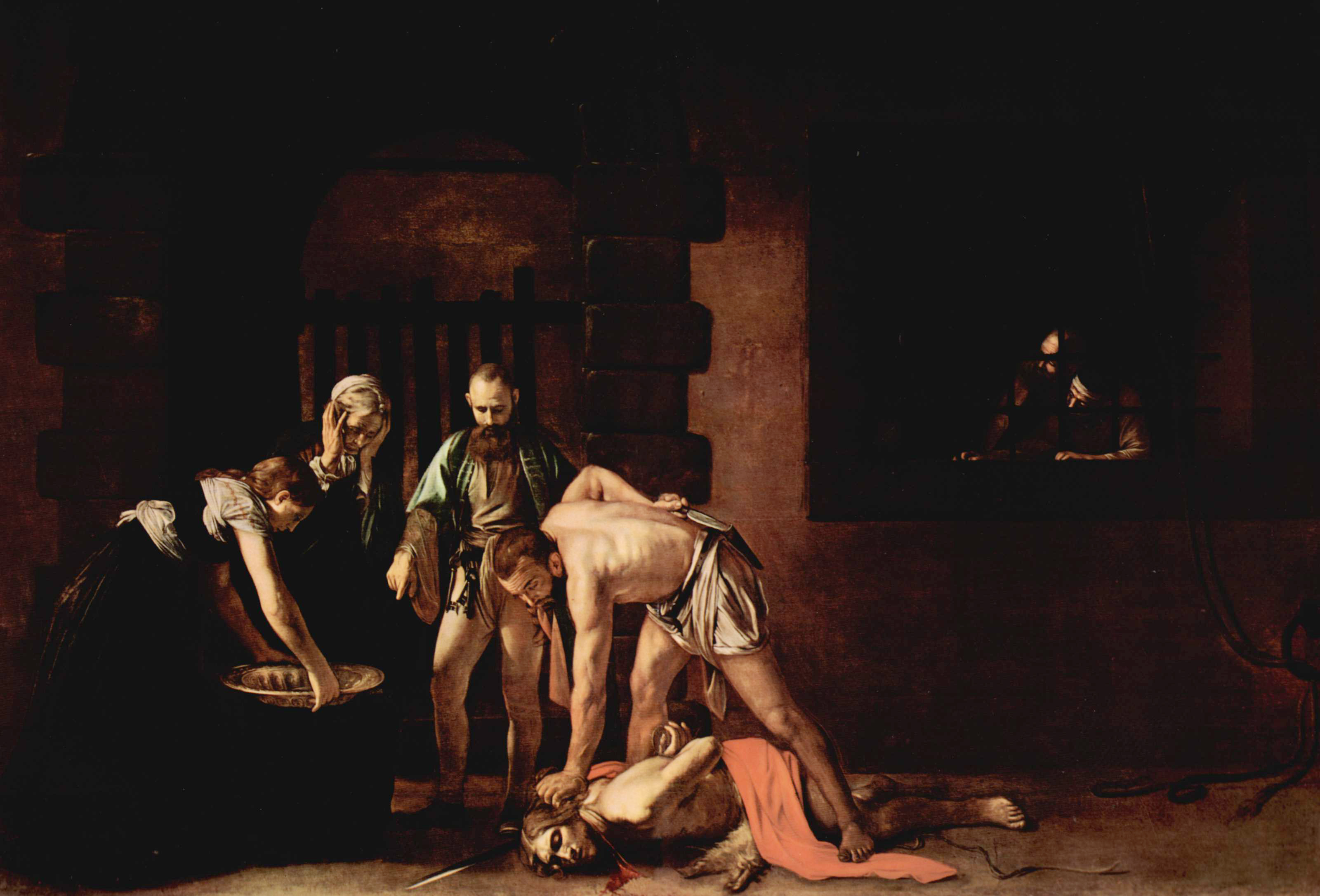
We've just been to St John’s Co-Cathedral in Valetta and met up with Caravaggio’s masterpiece The Beheading of Saint John the Baptist. Ok, it's not exactly accessible, but an extraordinary visual reward is guaranteed. Painted for a side chapel in the Cathedral used by the Knights of Malta, this painting hangs behind the altar exactly where Caravaggio intended. It even witnessed the day the Knights of Malta gathered to defrock the artist after another unpardonable escapade. Like many other art pilgrimages it has its challenges but you’ll never see anything like it anywhere else.
Image: Sure it’s behind a sign and you share the space with a small crowd but there it is, Caravaggio’s The Beheading of Saint John the Baptist right where it belongs.
And then there's the works that will never be returned, the countless religious paintings and icons and sculptures that have been stripped from their context and narratives and put in museums. When you do get to see a great artwork in its original setting it's a startling experience.
We've just been to St John’s Co-Cathedral in Valetta and met up with Caravaggio’s masterpiece The Beheading of Saint John the Baptist. Ok, it's not exactly accessible, but an extraordinary visual reward is guaranteed. Painted for a side chapel in the Cathedral used by the Knights of Malta, this painting hangs behind the altar exactly where Caravaggio intended. It even witnessed the day the Knights of Malta gathered to defrock the artist after another unpardonable escapade. Like many other art pilgrimages it has its challenges but you’ll never see anything like it anywhere else.
Image: Sure it’s behind a sign and you share the space with a small crowd but there it is, Caravaggio’s The Beheading of Saint John the Baptist right where it belongs.
Tuesday, May 14, 2013
Guarded
On Saturday in New York we were able to see not one but two big exhibitions of Jeff Koons. Infamously the two shows were on at two competing dealer mega galleries Gagosian and David Zwirner. David Zwirner has only ever lost one of his big-time artists (that was Franz West and he went to Gagosian) and Gagosian doesn't like losing anything so all eyes are on how this Koons arrangement evolves. And how the hell Koons pulled off this doubles stunt is anyone’s guess but it's definitely a muscle flexing demo of his pulling power with rich collectors. Anyway there were Koons to burn at both barn-sized spaces but very different approaches to their ARIPs (Audience Relationship Interface Protocols).
Gagosian was guard heavy. Ten of them in fact (more than one per work which were in fairness finger-licking shiny stainless steel) and dressed in black along with a grey-suited boss who scuttled around repositioning his team like a neurotic cricket captain adjusting the out field. No touching, no photography, no bags. When we did take a photo from the street through the window a guard inside was not a happy person.
At Zwirmer's a couple of guards handled the whole area. Photography was fine, posing in front of the works was ok and bags and backpacks didn’t seem to be a problem.
Then we went to Zwirner’s other gigantic gallery on the next block to look at sculpture from another galaxy altogether.
Images: Guarding Koons at David Zwirner Gallery in Chelsea.
Thursday, May 9, 2013
Crowd sourcing II
All public art museums crave to attract more people through their doors. Attendances often determine how much sun will shine on them from their funders who in NZ's case are mostly local and regional authorities. Take Auckland Art Gallery for instance. Its council ‘owner’ Robert Domm, the chief executive of Regional Facilities Auckland (RFA), is focussed on the Gallery “enhancing its commercial performance” and that aspiration is a very powerful shaping idea. But, be careful what you wish for. We found our visit to the Museum of Modern Art dispiriting. Commercially successful? No doubt but by pulling in the crowds MoMA has sacrificed what you'd have thought were two of its most important roles; the protection of works of art and the protection of the experience of those works of art.
Hundreds of people rushed through the galleries brushing against paintings, jostling for position in front of famous works and suddenly stopping dead or lurching away as the audio guide spun them round. The guards had all but given up in the face of such crowds only occasionally calling “no flash” if only to prove they even existed. Wow. Meanwhile down the road the sexy fashion brand Abercrombie & Fitch kept eager punters waiting in a line outside its Manhattan flagship store until there was space for them to properly enjoy the store. The priority of A&F (like the Barnes collection in Philadelphia) is the experience once you get inside and that's what they protect. MoMA's priority seems to be to take the money and run. Their approach to what the crowds get as an experience (or rather non-experience) at thirty bucks a head? Not our problem.
Images: top left, crowds form at the ticket office and right, they’re off, the rush to the ‘best’ galleries. Middle, six deep at audio tour stops and bottom, shadow play delivers Douglas Gordon’s poignant video Play dead; real time straight back to the circus.
Monday, May 6, 2013
Big
Apart from photographing your friends posing in front of works in art museums (we've recently watched a ten minute set of mimic-poses in front of Andy Warhol’s painting Ethel Scull 36 times that would have done a professional model shoot proud) there’s a new kind of photography in town. Museum visitors are starting to use the zoom feature on their phone cameras to record those illusive details you miss. A whole new micro world of art is coming into focus - and with an iPad of course the experience is hugely magnified.
How will the museums respond? Well if people can have an intimate close-up view of works their experience will be very different and they'll have different kinds of questions. There's not much point blandly announcing on a label that a knife is richly illustrated with animal figures if the visitor via a few camera shots has already discovered that the animals all have human heads and they seem to have weapons drawn. As they say in Starshiptroopers, "Do you want to know more?" This is a different way of looking that will demand different ways of presentation and interpretation. Good luck with that.
Images: top left to right, James Ensor Masks confronting death, Henri Matisse The goldfish bowl, Caesar captive before Shopur II, Seal ring in the name of Hajji Muhammad Mahmud, El Anatsui's Dusasa II and Alberto Giacometti's City square (Details follow in the same order).
Wednesday, May 1, 2013
Pumping
Four years ago we posted on the RockyBalboa sculpture that had been banished from the doors of the Philadelphia Museum of Art to the foot of the grand stairway leading up to it. A demotion perhaps but you can't keep Rocky down. The first movie may have opened back in 1976 but still the man is the centre of attention with a line of people waiting to be snapped in the Rocky pose.
Images: Top, Sylvester Stallone takes the pose in the first movie and the sculpture as seen as a prop in Rocky III outside the Philadelphia Museum of Art. Bottom, families pose with the statue where it stands today.
Thursday, April 25, 2013
working the wall
The Cleveland Museum of Art has been inundated with praise for its digital innovations. We drove up there to check out its prime exhibit - The Wall. This is not some cheesey Pink Floyd rehabilitation (although Cleveland does happen to be the home of the Rock and Roll Hall ofFame) but a significant advance in how to add a digital dimension to an art audience experience. And it’s impressive. It makes you feel a bit like Tom Cruise in Minority Report. Back in 2002 when he manipulated data and images with a flick of the wrist it felt like science fiction. No more. The Wall is just like that. You can theme, you can choose, you can share your selections. At its most spectacular The Wall shows thousands of small images of every object in the Museum's collection. Touch one and it expands to give you more info, connections to similar objects in the collection, ways to make your tour for others to share. You can also rent an iPad (five bucks) to locate yourself in the galleries, tell you what's close to you, give more info, tell stories, email your photos. In some ways it's art education on speed with images and info zapping past as you figure out the system, but it lacks the attitude and personality of MoNA's O. As nothing is going to stop this born again museum education fever though, get used to it. A huge upside at Cleveland is that because they are presenting so many images digitally themselves, you using your own phone and camera is just fine. You can see a short clip of the wall in action here.
Images: top, Cleveland's digitised collection on view. Middle, visitors selecting their favourites. Bottom, using the iPad to locate, expand and photo works in the galleries.
Tuesday, April 23, 2013
The play way
A sculpture park in St Louis turned out to be a surprise. For a start there's its superb location in the middle of downtown near the famous Eero Saarinen Gateway Arch. And then there's the way it is used. People in this city seemed to love it and want to spend time there. You forget how unusual is it to see crowds of people not only physically enjoying sculpture but also including it in the important events of their lives.
We happened to be in St Louis on Prom weekend and the place was packed with limos, anxious parents and hundreds of dressed-up kids looking for special places to be photographed. OK, the Gateway Arch was first pick but a close second was the Citygarden sculpture park. The GatewayFoundation owns the works and it obviously believes that any scuffing or wear can be readily repaired. And so there are no do not touch signs, no keep off the art notices and no barriers.
At the far end of the park a striking but sombre work by Richard Serra was left to its own devices but most everything else was in use. Kids climbed the Mark di Suvero, people imitated Julian Opie's LED walking figures, a family explored the inside of a large bronze head by Igor Mitoraj, a couple fooled around with Jim Dine's Big white gloves and prom celebrants used anything that was going to complement their striking poses.
Images: top, Climbing Mark di Suvero’s Aesop’s fables. Second row, photographing Prom outfits on Untitled (two rabbits) by Tom Claasen. Third row left, striking a pose in front of Jim Dine’s Big white gloves, big four wheels and right, kids clambering out after hiding in Eros Bendato by Igor Mitoraj. Bottom, a very McCahon-like view of the garden through a portal in Richard Serra’s Twain
Sunday, April 14, 2013
Figure in ground
It’s about two and a half hours drive out of Salt Lake City with the last ten or so on well sign-posted gravel roads. Despite warnings that it was too early in the season for Robert Smithson's Spiral Jetty to be reliably visible, there it was. But until we got there who knew the lake, surrounding mountains and sky were going to present such a spectacular setting? As for the Spiral jetty, well it looked just like it does in the pictures. But, hang on a minute, what’s that big post stuck right bang in the middle? It turns out there’s a guy standing at the very end tip of the spiral. It’s a Spiral Jetty nightmare. In all fairness he just waded around for a few minutes and then came on in so we could take the same uninterrupted human-free pictureseveryone else does.
Truthfully in the two hours we were there we mostly had it to ourselves but we did see a bunch of guys on trail bikes and customised bikers suits, a young artist who was a Perec fan and her dad from Salt Lake City, a couple of guys (one was spiral guy) with a very old dog, a small plane (the trail bike crowd raised pretend guns to shoot it down), and flocks of migrating birds. It was warm and perfectly still.
Let Smithson have the last word. “This site was a rotary that enclosed itself in an immense roundness. From that gyrating space emerged the possibility of the Spiral Jetty. No ideas, no concepts, no systems, no structures, no abstractions could hold themselves together in the actuality of that evidence.”
Image: Spiral guy.
Tuesday, February 26, 2013
Sunday, February 3, 2013
Onward my brave Hawkmen
It’s not everyday that the people running our cultural institutions let their guard down and reveal what they're thinking - particularly about the future and how it might affect their audiences. In the weekend a long piece in the DominionPost got Te Papa CEO Michael Houlihan to open up on the ways Te Papa intends to implement its radical new plan to split into a museum of living culture and a museum for the future. They are:
Create a display of a Gallipoli trench
Display more of the fine art collection
Continue showing art on the fifth floor
Collect furniture
Collect video games
Change the Treaty of Waitangi exhibit
Exhibit more photography
Record plays and performances
Tour Te Papa exhibitions
Not be the home of the usual museum-going crowd
Let the magic begin
Image: Red stave chair by Humphrey Ikin purchased for the Te Papa collection in 1997
Sunday, January 20, 2013
Strong words
"I always saw the role of director as primarily to lift people to paradise and to give them information and delight – and then, at another moment, claw them, so they were absolutely shocked and they were made to think about what was going on around them. It wasn't all about delight.”
Sir Roy Strong former director of the Victoria and Albert Museum (V&A) and the National Portrait Gallery in London
Wednesday, January 16, 2013
On guard
Over the years we've bombarded you with pics of stanchions, barriers and pine cones (true) being used to protect art works, sometimes ruining them, sometimes adding a hilarious new dimension. Art museums have another weapon to keep us away from their art: guards. We’ve already had a look at their reading choices and the move from books to phones, but how about the aesthetics of minding.
Here’s one photo taken by us at the Shanghai Biennale of a guard completely unaware that the video he is protecting has long since stopped playing along with two images from Andy Freeburg’s book Guardians ofthe Russian Museums. This wonderful collection of photographs suggests that guards become like the pictures they attend, something like people and their dogs. It was Freeburg who made our favourite art people photographs, the top of dealer gallery staffers' heads poking up above hefty reception counters. As for our favourite guard response to someone actually trying to touch something? Still got to be from the movie Night at the museum: battle of the Smithsonian, “How dare you! If you touch that again I shall kill you right now.”
Images: Top, Shanghai Biennale guard. Bottom, woman guarding art in Moscow’s State Tretyakov Gallery photographed by Andy Freeburg.
Sunday, January 13, 2013
Tuesday, December 11, 2012
The things that count at Te Papa
Looking at the attendance figures in Te Papa’s Annual Report we were struck by the fact that there were no figures allocated to people under the age of 16. Given the huge push Te Papa puts on education for young people, the fact that school groups at least must book in it seemed kind of weird. There was of course the possibility that Te Papa are trying to downplay the perception of them as a ‘children’s museum’.
Te Papa tells us that because of “legal reasons” (don’t ask) they can only extract a very limited amount of information from people under 16. However they “estimate” that the under 16s represented 289,845 of the 1,377,173 visitors last year (that’s only 21 percent). As to how many of those were voluntary ie don’t come on organized visits is anybodies guess – our guess is around 60,000. So why the all the dumbing down with the simplistic labels, the obvious themes, the art way up on the top floor and the fun and games in the main foyer etc?
And why is the under 16 figure just an ‘estimate’? Even if they can’t find out what the young people are up to after dark they do at least know how many of them are under the age of 16 even if it is just by elimination.
We also asked Te Papa how they actually counted people and it turns out they use “a thermal camera, with a back up intercept beam”, so it’s all very Flash Gordon at the front door.
Image: a thermal camera
Wednesday, November 21, 2012
Munchkins
In a new museum photo craze many visitors have traded in taking pics of the paintings to taking pics of themselves mugging the paintings. One of our favourite sites Hyperallergic trawled up a good range of examples from MoMA's Twitter stream featuring some ‘Screamers’ in action. They also pointed their readers to this nice Scream animation.
Tuesday, November 13, 2012
Digital dreams
The art museum world has been pretty slow at coming to terms with the digital world. Even now, and after a considerable amount of encouragement and enthusiasm by Best of 3, they are still really only just at the getting-the-collection-online and maybe-blogging-once-in-a-while stage.
The exception is of course the Christchurch Art Gallery who blog regularly, sometimes provocatively and often amusingly once a day at least and have introduced My gallery image sets as a way of life for many of their fans. The fact is the digital world is fast and rapacious so blogging once a week or putting up a future exhibitions programme that’s just a list, or not having pics of your latest exhibition up three tenths of a second after the show opens (well at least before EyeContact puts them up for you) is kind of lame.
Here’s a list of things we have assembled from talking around and asking people what they would like to see on art museum web sites.
- A constantly updated and annotated list of the latest art books. With no art bookshop left in Auckland (or anywhere else for that matter) this information is now hard to get unless you are professionally engaged.
- Images of the current exhibitions on show (videos would be nice too). It won’t stop people coming (honest).
- Use Tweeting as a communication tool not just a promotional one - it's hard to respond to things that are just about how-amazing-we-are.
- YouTube movies of all talks and lectures the day after they are given. And what with Skype being free and all how about including some off-shore people into some of these discussions.
- The opportunity for the public to join in on cataloguing your collection with tagged information and stories, the Smithsonian already does this on Flickr
- Regular posts, tweets or sets on great objects in the collection you don’t have space to show.
- Pdfs of all your printed catalogues from day one (Volunteers will do the scanning for you)
- A personal report with pics from any curators who’s scored an overseas trips, telling us what’s going on out there (doesn’t have to be formal or the opinion of the institution and could start with Tweets or posting during the trip).
- At least one thing that will give people a laugh once a week
- A chance to donate toward purchasing specific art works for the collection Kickstarter style
There’s plenty more where that came from (thanks G and M), but that’ll do for now.
Wednesday, October 17, 2012
That’s the spirit
In our continuing quest to track art museum tie-ins designed by marketers to attract audiences, how about this effort from the Denver Museum? The exhibition coming up was BecomingVan Gogh. What do you think the team came up with to get more cash in the till?
Who guessed a specially brewed beer along with a name-the-beer competition offering a prize of free tickets, a Van Gogh t-shirt and discount voucher? Very Vincent.
Still could have been worse, they might have teamed up with Mademan.com and had their absinthe-based cocktail Van Gogh’s ear (fill a Collins glass with ice and dribble two oz. of absinthe slowly into the glass. Add a slice of lemon and pour grapefruit juice into the glass. Swirl in an oz. of grenadine) on offer at the door.
Subscribe to:
Posts (Atom)